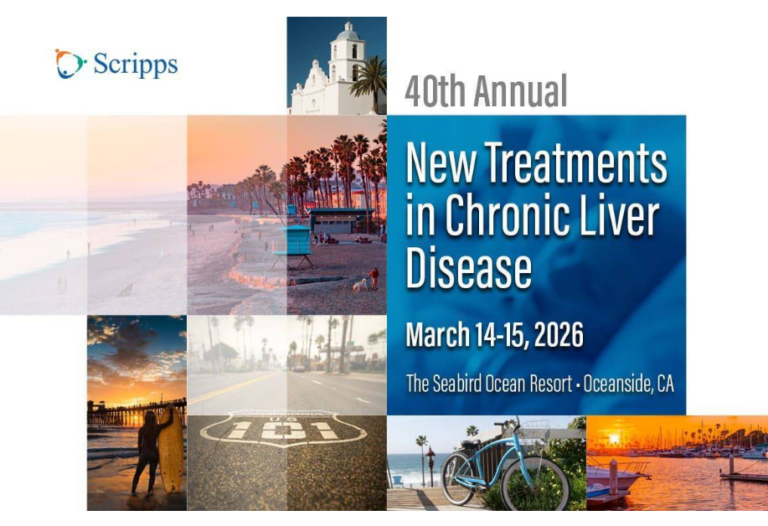
Scripps 40th Annual New Treatments in Chronic Liver Disease 2026
$30.00
This Product is shared via google drive download link, So please share your correct Gmail id while placing the order .Please note that there are no CME points or certificate associated with this course Samples for Courses Can be found here : Free Samples Here!
Scripps 40th Annual New Treatments in Chronic Liver Disease 2026
Advanced Hepatology Updates in MASH, Viral Hepatitis, Autoimmune Liver Disease & Liver Transplantation
Chronic liver disease is evolving rapidly as new metabolic syndromes, antiviral therapies, fibrosis-directed treatments, and transplant strategies reshape modern hepatology practice. The Scripps 40th Annual New Treatments in Chronic Liver Disease 2026 program provides a clinically focused review of the latest developments in liver disease diagnosis, therapeutics, and transplant medicine, with particular emphasis on emerging metabolic liver disorders, functional viral hepatitis cures, autoimmune hepatology, and complications of advanced cirrhosis.
This annual Scripps conference explores the changing landscape of hepatology through expert-led discussions, panel reviews, and evidence-based clinical updates designed for physicians managing increasingly complex liver disease populations.
The educational package includes:
- 13 Video Lectures
- 13 Subtitle Files (.vtt)
- 12 PDF Files
- Total Size: 3.48 GB
- Course Year: 2026
The course reflects how hepatology is shifting from largely supportive management toward precision medicine, targeted biologics, metabolic intervention, and disease-modifying therapies.
The Rapid Transformation of Modern Hepatology
Over the past decade, hepatology has undergone major transformation due to advances in:
- Antiviral therapies
- Fibrosis assessment
- Metabolic liver disease classification
- Immunologic treatments
- Transplant optimization
- Noninvasive diagnostics
- Hepatocellular carcinoma therapies
At the same time, clinicians increasingly face rising prevalence of:
- Obesity-associated liver disease
- Alcohol-related liver disease
- Combined metabolic and alcohol-associated liver injury
- End-stage liver complications
The course repeatedly emphasizes that liver disease management now requires broader multidisciplinary integration involving:
- Endocrinology
- Obesity medicine
- Addiction medicine
- Oncology
- Transplant medicine
- Interventional radiology
MetALD: An Emerging Clinical Entity
One of the most clinically important topics covered is MetALD (Metabolic dysfunction-associated Alcohol-related Liver Disease).
This emerging classification reflects the growing recognition that many patients demonstrate overlapping:
- Metabolic dysfunction
- Obesity-related liver injury
- Alcohol-associated hepatic damage
rather than fitting into purely isolated diagnostic categories.
The lectures examine:
- Diagnostic criteria
- Risk stratification
- Disease progression
- Metabolic risk factors
- Management strategies
In practice, distinguishing metabolic and alcohol-related contributions to liver disease can be challenging because both pathways frequently coexist and synergistically worsen fibrosis progression.
MASH Cirrhosis & Disease Reversibility
The MASH (Metabolic dysfunction-associated Steatohepatitis) sessions review:
- Fibrosis progression
- Cirrhosis reversibility
- Emerging anti-fibrotic therapies
- Weight reduction strategies
- Metabolic interventions
One of the more important evolving concepts in hepatology is the possibility that even advanced fibrosis and compensated cirrhosis may demonstrate partial reversibility under certain treatment conditions.
The course explores:
- Histologic improvement data
- Clinical trial evidence
- Pharmacologic therapies
- Lifestyle interventions
- Bariatric and obesity medicine considerations
Obesity Treatment & Liver Disease
The obesity medicine discussions appropriately recognize obesity as a central driver of modern hepatology practice.
Topics include:
- Weight reduction therapies
- GLP-1 receptor agonists
- Metabolic syndrome management
- Hepatic steatosis reduction
- Cardiometabolic risk improvement
As obesity-related liver disease becomes increasingly prevalent worldwide, clinicians must integrate:
- Nutrition management
- Endocrine therapy
- Cardiovascular risk reduction
- Behavioral medicine
into liver disease treatment planning.
Viral Hepatitis & Functional Cure Strategies
The viral hepatitis sessions provide updates on:
- Hepatitis B functional cures
- Hepatitis C management
- Delta hepatitis treatment advances
- Antiviral therapy optimization
The concept of “functional cure” in hepatitis B represents one of the most important evolving areas in hepatology.
The course reviews:
- Novel antiviral strategies
- Immune-targeted therapies
- Viral suppression goals
- Long-term monitoring considerations
The delta hepatitis discussions are particularly relevant because HDV remains one of the most aggressive viral liver diseases, historically associated with limited treatment options.
Autoimmune Liver Disease Updates
The autoimmune hepatology sections examine:
- Autoimmune hepatitis
- Primary biliary cholangitis (PBC)
- Primary sclerosing cholangitis (PSC)
- Novel biomarkers
- Emerging therapies
Autoimmune liver diseases remain diagnostically and therapeutically complex because disease activity, fibrosis progression, and treatment response can vary substantially among patients.
The course highlights evolving therapeutic approaches and updated understanding of disease mechanisms.
Drug-Induced Liver Injury (DILI)
The DILI discussions focus on:
- Diagnostic evaluation
- Pattern recognition
- Medication-related hepatotoxicity
- Differential diagnosis challenges
Drug-induced liver injury remains one of the most difficult areas in hepatology because presentations often mimic:
- Viral hepatitis
- Autoimmune disease
- Cholestatic disorders
- Acute liver failure syndromes
The lectures emphasize careful clinical reasoning and exclusion-based diagnosis.
Hepatocellular Carcinoma (HCC)
The HCC sections review:
- Liver mass evaluation
- Screening strategies
- Emerging systemic therapies
- Multidisciplinary management
- Transplant considerations
Hepatocellular carcinoma management has changed dramatically with the introduction of:
- Immunotherapy combinations
- Targeted therapies
- Locoregional treatment advances
The course explores how evolving oncology therapies are reshaping prognosis and treatment sequencing in advanced liver cancer.
Ascites & Hepatorenal Syndrome
Management of advanced cirrhosis complications remains a major focus.
Topics include:
- Ascites management
- Hepatorenal syndrome
- Volume management
- Albumin use
- Renal support strategies
Clinical decision-making becomes particularly difficult in decompensated cirrhosis where:
- Portal hypertension
- Renal dysfunction
- Infection risk
- Hemodynamic instability
often coexist simultaneously.
Liver Transplant Selection & Advanced Hepatology Care
The transplant board sessions review:
- Candidate selection
- MELD prioritization
- Contraindications
- Comorbidity assessment
- Long-term transplant outcomes
As liver disease therapies continue improving, transplant evaluation increasingly involves balancing:
- Disease reversibility potential
- Frailty assessment
- Malignancy risk
- Cardiometabolic disease burden
The course appropriately emphasizes multidisciplinary transplant decision-making.
Real-World Clinical Relevance
A major strength of the conference is its focus on clinically actionable hepatology.
The sessions repeatedly address:
- Translating clinical trial data into practice
- Evidence-based therapeutic selection
- Longitudinal liver disease management
- Complication prevention
- Personalized patient care
- Emerging treatment pathways
The program reflects the reality that hepatology increasingly intersects with:
- Metabolic medicine
- Oncology
- Transplantation
- Immunology
- Preventive medicine
What’s Included
- 13 expert hepatology video lectures
- 13 subtitle files (.vtt)
- 12 downloadable PDFs
- Total size: 3.48 GB
- MASH and MetALD updates
- Viral hepatitis and delta hepatitis discussions
- Autoimmune liver disease reviews
- Liver transplant and HCC management sessions
Final Expert Perspective
Modern hepatology is undergoing a major shift as advances in antiviral therapy, metabolic medicine, immunology, fibrosis reversal research, and liver transplantation continue reshaping patient care. Clinicians increasingly manage highly complex patients with overlapping metabolic, inflammatory, infectious, and oncologic liver disease processes.
The Scripps 40th Annual New Treatments in Chronic Liver Disease 2026 program provides a clinically grounded and up-to-date review of these developments through expert-led discussions focused on practical management, emerging therapeutics, and evolving disease classification. For hepatologists, gastroenterologists, and transplant specialists seeking advanced updates in chronic liver disease management, this course offers a highly relevant and evidence-driven educational resource.
Topics
-
01 The Emerging Clinical Entity of MetALD Diagnosis, Risk, and Management
-
02 Treatment of MASH Cirrhosis Is it Reversible
-
03 Obesity Treatment The Essentials
-
04 Pediatric MASH Approaches to Diagnosis and Treatment VIDEO PDF NOT RELEASE
-
05 Panel Discussion Q&A
-
06 Updates on Diagnosis and Treatment of Autoimmune Hepatitis
-
07 Drug Induced Liver Injury
-
08 Hepatitis B Functional Cures
-
09 Using Medication Assisted Therapy in Hepatitis C
-
10 Delta Hepatitis
-
11 Panel Discussion Q&A
-
12 HCC VIDEO PDF NOT RELEASE
-
13 Transplant Selection Board
-
14 WILLIAM S. HAUBRICH LECTURE Updates in PBC and PSC
-
15 Panel Discussion Q&A
Related products

Internal Medicine

Anesthesiology & pain medicine
Internal Medicine

Internal Medicine
Anesthesiology & pain medicine
Critical Care Symposium: Mastering ED Mechanical Ventilation
Critical Care - Emergency medicine

USMLE / kaplan and Board Review
Uworld USMLE COMLEX Level 1 Qbank, Updated Jan 2023, System- and Subject-wise (PDF)