
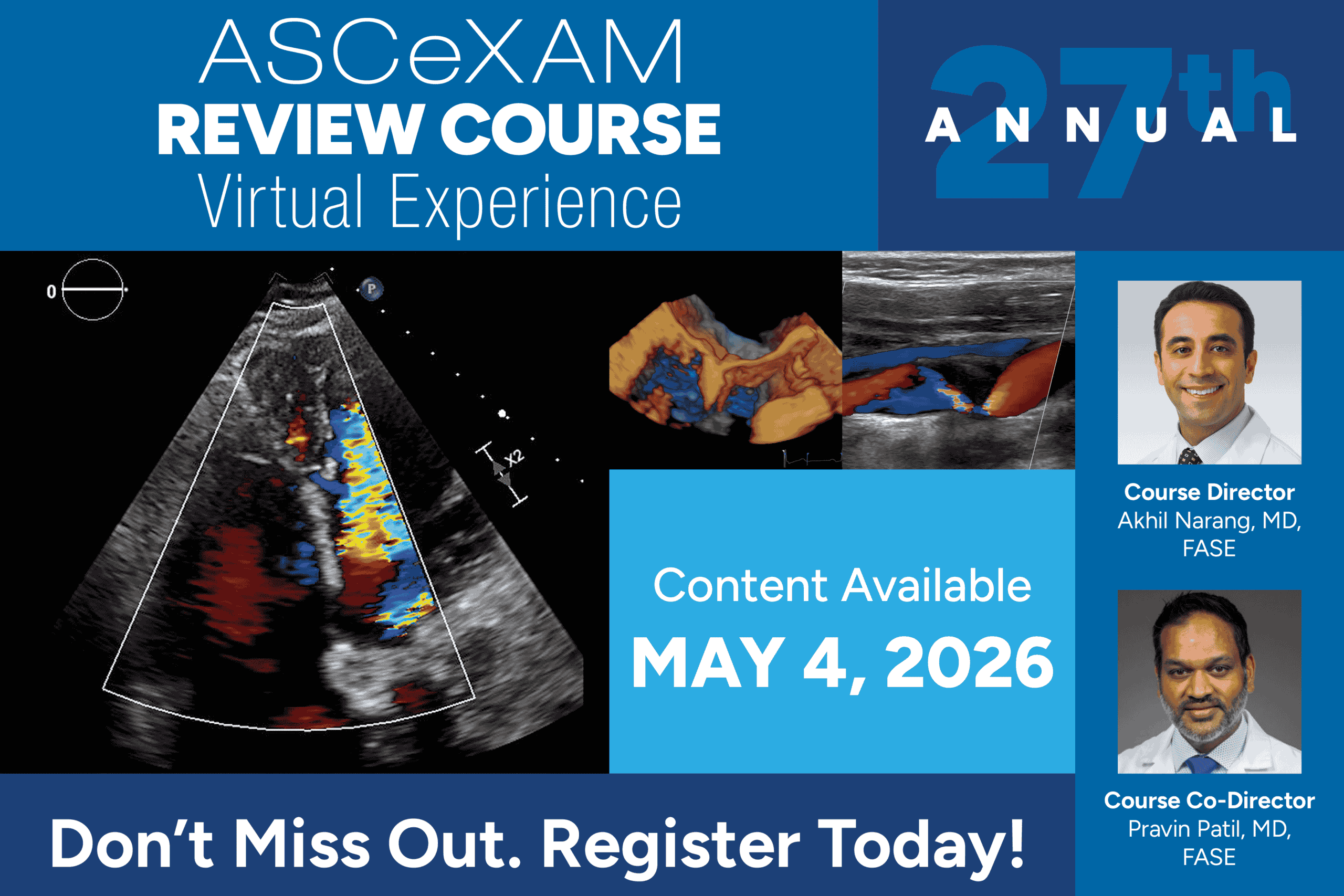
ASE 27th Annual ASCeXAM/ReASCE Review Course 2026


$110.00
This Product is shared via google drive download link, So please share your correct Gmail id while placing the order .Please note that there are no CME points or certificate associated with this course Samples for Courses Can be found here : Free Samples Here!



ASE 27th Annual ASCeXAM®/ReASCE Review Course 2026
Advanced Echocardiography Review for Cardiologists, Sonographers & Cardiovascular Imaging Specialists
The ASE 27th Annual ASCeXAM®/ReASCE Review Course 2026 is one of the most comprehensive and clinically detailed echocardiography review programs available for cardiovascular imaging professionals. Developed by the American Society of Echocardiography (ASE), this advanced educational course delivers a broad and in-depth review of modern cardiovascular ultrasound, integrating foundational ultrasound physics with advanced imaging interpretation, Doppler hemodynamics, valvular heart disease assessment, congenital heart disease, myocardial mechanics, structural heart intervention imaging, and board-focused quantitative review.
Designed both as:
- 🫀 A high-level clinical echocardiography update
- 🎓 A comprehensive ASCeXAM®/ReASCE board preparation course
this program reflects the increasing complexity of cardiovascular imaging in modern clinical cardiology.
The curriculum emphasizes how contemporary echocardiography now requires clinicians to integrate:
- Structural anatomy
- Hemodynamics
- Myocardial mechanics
- Doppler physiology
- Strain imaging
- Interventional imaging
- Quantitative calculations
into accurate, real-world patient assessment and management.
📦 Product Details
- 🎥 107 Video Lectures
- 📝 105 Subtitle Files (.vtt)
- 📄 56 PDF Files
- 💾 Total Size: 10.4 GB
- 📅 Course Year: 2026
- 🏥 Provider: American Society of Echocardiography (ASE)
- 🌐 Format: On-demand multimedia review course
Important Publisher Note
This course includes a substantial number of archived ASE educational lectures from prior releases. Additionally, two lectures contain audio defects originating from the original publisher source material.
🧠 Program Overview
Echocardiography remains one of the most indispensable tools in cardiovascular medicine.
In current clinical practice, echocardiography plays a central role in:
- Valvular heart disease evaluation
- Heart failure assessment
- Pulmonary hypertension analysis
- Structural intervention planning
- Congenital heart disease imaging
- Cardio-oncology monitoring
- Critical care cardiology
- Perioperative monitoring
- Hemodynamic assessment
Unlike many imaging modalities, echocardiography uniquely combines:
✔️ Real-time physiologic assessment
✔️ Structural visualization
✔️ Functional analysis
✔️ Procedural guidance
✔️ Portability
within a single noninvasive imaging platform.
The ASE review course is specifically structured around these evolving clinical demands, emphasizing both technical imaging mastery and advanced interpretation accuracy.
🎯 Educational Goals
By completing this course, participants will be able to:
✔️ Understand ultrasound physics and Doppler principles
✔️ Optimize echocardiographic image acquisition
✔️ Perform advanced valvular heart disease assessment
✔️ Interpret ventricular systolic and diastolic function
✔️ Apply strain and deformation imaging techniques
✔️ Evaluate congenital and structural heart disease
✔️ Utilize echocardiography during structural interventions
✔️ Perform board-level quantitative calculations
✔️ Integrate hemodynamic findings into clinical decision-making
✔️ Prepare for ASCeXAM® and ReASCE certification examinations
⚙️ Ultrasound Physics & Doppler Fundamentals
A major portion of the course focuses on the core physics underlying cardiovascular ultrasound.
Topics include:
- Basic ultrasound physics
- Doppler principles
- Spectral Doppler interpretation
- M-mode echocardiography
- Image optimization (“knobology”)
- Artifact recognition
- Hemodynamic equations and formulas
The lectures repeatedly emphasize that many echocardiographic errors arise from:
- Poor image acquisition
- Doppler misalignment
- Gain adjustment problems
- Technical limitations
- Artifact misinterpretation
rather than interpretation alone.
Participants learn how image quality and Doppler accuracy fundamentally determine diagnostic reliability.
❤️ Hemodynamics & Ventricular Function Assessment
The ventricular assessment sessions examine:
- Right ventricular function
- Left ventricular systolic performance
- Chamber quantification
- Ventricular remodeling
- Pulmonary pressure estimation
- Hemodynamic calculations
Modern echocardiography increasingly depends on integrating:
✔️ Doppler findings
✔️ Filling pressures
✔️ Ventricular geometry
✔️ Strain imaging
✔️ Clinical symptoms
into meaningful physiologic assessment.
The course provides extensive review of these integrated concepts and practical interpretation strategies.
🫀 Diastolic Function & Heart Failure Imaging
Diastology remains one of the more technically challenging areas in echocardiography.
Topics include:
- Diastolic dysfunction grading
- Restrictive physiology
- Filling pressure estimation
- Age-related changes
- Heart failure phenotyping
Because diastolic measurements can be influenced by:
- Age
- Loading conditions
- Heart rate
- Valve disease
- Rhythm abnormalities
the course emphasizes careful clinical correlation and integrated interpretation.
Heart failure imaging discussions also include:
- Advanced heart failure physiology
- LV assist devices (LVADs)
- Cardiac transplantation imaging
- Hemodynamic monitoring
💓 Comprehensive Valvular Heart Disease Imaging
Valvular pathology represents one of the largest and most clinically important portions of the curriculum.
Topics include:
- Mitral stenosis
- Degenerative mitral valve disease
- Functional mitral regurgitation
- Aortic stenosis
- Aortic regurgitation
- Prosthetic valve assessment
- Tricuspid valve disease
- Pulmonary valve pathology
The lectures strongly emphasize integrated valve assessment rather than isolated parameter interpretation.
Participants learn how valvular imaging becomes particularly challenging when:
✔️ Multiple valve lesions coexist
✔️ Low-flow states alter Doppler measurements
✔️ Ventricular dysfunction affects gradients
✔️ Prosthetic valves create artifact
✔️ Hemodynamics complicate severity estimation
The course reviews practical strategies for resolving these complex diagnostic dilemmas.
🧬 Advanced Echocardiographic Imaging Techniques
Several lectures focus on contemporary imaging innovations increasingly influencing cardiovascular care.
Advanced topics include:
- 3D echocardiography
- Strain/deformation imaging
- Contrast echocardiography
- Handheld ultrasound
- Interventional echocardiography
Strain Imaging Applications
Particular emphasis is placed on:
- Cardio-oncology monitoring
- Early cardiomyopathy detection
- Subclinical ventricular dysfunction
- Valvular disease assessment
Interventional Echocardiography
Structural heart imaging topics include:
- Transcatheter valve procedures
- Device placement guidance
- Intraprocedural monitoring
- Structural intervention planning
🫁 Stress Echocardiography & Ischemic Heart Disease
The stress echocardiography modules review:
- Ischemia detection
- Wall motion analysis
- Stress imaging protocols
- Exercise vs pharmacologic stress
- Hemodynamic responses
Stress echocardiography remains clinically valuable because it simultaneously evaluates:
✔️ Myocardial ischemia
✔️ Functional physiology
✔️ Structural adaptation
✔️ Dynamic cardiac performance
🧠 Cardiomyopathies & Systemic Disease
The course also examines:
- Hypertrophic cardiomyopathy
- Athlete’s heart
- Restrictive cardiomyopathies
- Infiltrative disease
- Pericardial pathology
- Systemic disease manifestations
Special focus is placed on differentiating:
- Physiologic remodeling
- Hypertensive remodeling
- Early hypertrophic disease
- True cardiomyopathy
through advanced echocardiographic pattern recognition.
👶 Congenital Heart Disease & Fetal Echocardiography
Congenital imaging sections address:
- Adult congenital heart disease
- Complex congenital anomalies
- Structural abnormalities
- Fetal echocardiography principles
As survival improves in congenital heart disease patients, adult cardiologists increasingly encounter:
✔️ Repaired congenital lesions
✔️ Residual defects
✔️ Lifelong imaging surveillance needs
making congenital echocardiography education increasingly important.
🦠 Endocarditis, Cardiac Masses & Embolic Sources
Additional clinically important topics include:
- Infective endocarditis
- Prosthetic valve infection
- Cardiac masses
- Embolic source evaluation
- Myocardial infarction complications
The course emphasizes echocardiography’s essential role in detecting:
✔️ Vegetations
✔️ Valve destruction
✔️ Abscesses
✔️ Intracardiac thrombi
✔️ Mechanical complications of infarction
🏥 Structural & Interventional Echocardiography
One of the fastest-growing applications of echocardiography is structural heart imaging.
The interventional echo primer reviews:
- Structural heart procedures
- Transcatheter valve interventions
- Device implantation
- Intraprocedural imaging guidance
- Hemodynamic monitoring during intervention
This section highlights the expanding role of advanced imaging specialists in modern cardiovascular procedures.
❓ Board Review & Formula-Based Learning
Because this course also serves as a certification review program, it includes:
- High-yield formulas
- Quantitative calculations
- ASE guideline integration
- Exam-focused concepts
- Doppler equations
The formula sessions reinforce:
✔️ Valve area calculations
✔️ Pressure gradient estimation
✔️ Hemodynamic equations
✔️ Doppler relationships
✔️ Quantitative interpretation skills
making the program highly valuable for ASCeXAM® and ReASCE preparation.
👨⚕️ Target Audience
This course is ideal for:
- Cardiologists
- Echocardiographers
- Cardiovascular imaging specialists
- Cardiology fellows
- Sonographers
- Advanced practice providers in cardiology
- Physicians preparing for ASCeXAM® or ReASCE certification
It is especially valuable for clinicians seeking:
✔️ Advanced echocardiography interpretation skills
✔️ Structural heart imaging education
✔️ Board review preparation
✔️ Hemodynamic mastery
✔️ Contemporary cardiovascular ultrasound updates
🎓 Educational Features
✔️ Comprehensive Echocardiography Curriculum
Covers foundational principles through advanced cardiovascular imaging.
✔️ Board-Focused Quantitative Review
Excellent preparation for ASCeXAM® and ReASCE certification exams.
✔️ Advanced Structural & Valvular Imaging
Strong emphasis on modern interventional and valvular echocardiography.
✔️ Integrated Hemodynamic Interpretation
Combines physiology, Doppler, and clinical reasoning.
✔️ Contemporary Imaging Innovations
Includes strain imaging, 3D echo, contrast imaging, and handheld ultrasound.
⭐ Why This Course Stands Out
✔️ One of the Most Comprehensive Echo Review Courses Available
Broad and detailed coverage across the entire echocardiography spectrum.
✔️ ASE Guideline-Based Education
Developed by the leading professional society in cardiovascular ultrasound.
✔️ Excellent Board Preparation Resource
Strong focus on formulas, calculations, and certification-level concepts.
✔️ Advanced Clinical Relevance
Highly applicable to modern heart failure, structural, and interventional cardiology practice.
✔️ Strong Integration of Physics + Clinical Interpretation
Bridges technical imaging acquisition with advanced clinical decision-making.
🚀 Clinical Value
The ASE 27th Annual ASCeXAM®/ReASCE Review Course 2026 provides a highly advanced and clinically integrated review of:
- Ultrasound physics
- Doppler hemodynamics
- Valvular heart disease
- Ventricular function
- Diastology
- Stress echocardiography
- Structural interventions
- Congenital heart disease
- Strain imaging
- Interventional echocardiography
- Cardiac masses
- Endocarditis
- Board-level quantitative calculations
By integrating:
✔️ Technical imaging mastery
✔️ Hemodynamic interpretation
✔️ Quantitative assessment
✔️ Contemporary cardiovascular applications
✔️ Evidence-based echocardiography practice
this course remains one of the premier educational resources available for cardiologists, echocardiographers, sonographers, fellows, and cardiovascular imaging specialists in 2026.
Related products

Critical Care - Emergency medicine

Critical Care - Emergency medicine
Critical Care - Emergency medicine
ASN Critical Care Nephrology – 2022 Update (On-Demand and Livestream)

Critical Care - Emergency medicine

Anesthesiology & pain medicine

Cardiology

Critical Care - Emergency medicine
Internal Medicine