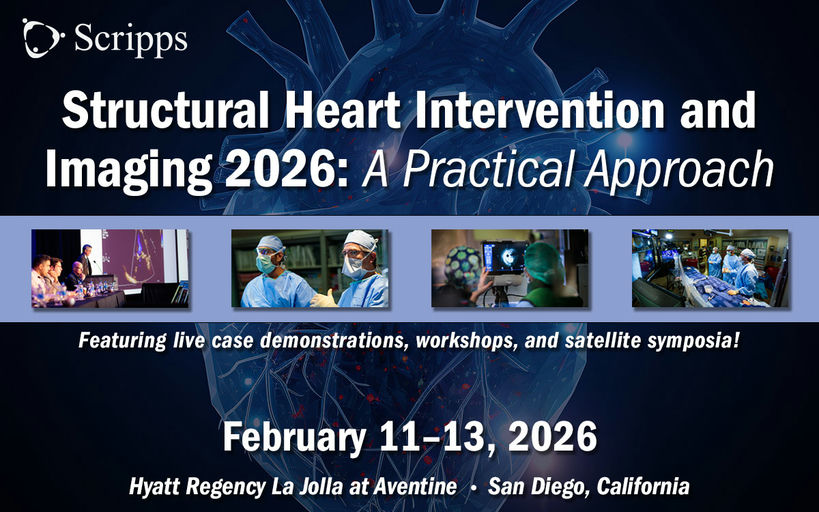
Scripps 15th Annual Structural Heart Intervention and Imaging 2026
Introduction
The Scripps 15th Annual Structural Heart Intervention and Imaging 2026 program delivers an advanced, case-based educational review of structural heart disease interventions, transcatheter therapies, and contemporary cardiovascular imaging strategies. Developed through Scripps Health, this multidisciplinary course examines the rapidly evolving field of catheter-based structural heart intervention with a strong emphasis on procedural imaging, patient selection, perioperative management, and complication prevention.
Held on February 12–13, 2026, the program combines expert-led lectures with live case-based education focused on transcatheter edge-to-edge repair (TEER), transcatheter aortic valve replacement (TAVR), transcatheter tricuspid valve replacement (TTVR), left atrial appendage occlusion (LAAO), patent foramen ovale closure, and emerging structural heart technologies. The curriculum also highlights advanced procedural imaging using transesophageal echocardiography (TEE), intracardiac echocardiography (ICE), cardiac CT, MRI, and multiplanar 3D imaging guidance.
Faculty include interventional cardiologists, echocardiologists, electrophysiologists, cardiothoracic surgeons, anesthesiologists, and sonographers who provide practical insight into multidisciplinary structural heart management, imaging integration, procedural planning, and long-term patient outcomes.
Files Included
The Scripps Structural Heart Intervention and Imaging 2026 educational package includes a comprehensive collection of structural cardiology learning materials optimized for advanced cardiovascular education and procedural review.
Included resources:
- 62 HD video lectures
- 62 subtitle files (.vtt)
- 51 downloadable PDF presentations
- Total course size: 30.98 GB
- Live case-based cardiovascular education sessions
- Structural heart intervention learning modules
- Advanced imaging educational content
- Downloadable procedural and imaging resources
- Multimedia cardiovascular learning materials
These resources support flexible self-paced study and long-term review of advanced structural heart interventions and cardiovascular imaging techniques.
Why This Course Is Important
Structural heart disease intervention has rapidly transformed cardiovascular medicine through the expansion of minimally invasive transcatheter therapies and sophisticated imaging-guided procedural techniques. Advances in TAVR, TEER, TMVR, TTVR, LAA closure, and complex valve interventions now require close collaboration between imaging specialists, interventional cardiologists, surgeons, anesthesiologists, and multidisciplinary structural heart teams.
At the same time, procedural success increasingly depends on advanced echocardiographic guidance, CT planning, 3D ICE integration, complication prevention strategies, and accurate patient selection. Structural heart specialists are now expected to navigate highly complex procedural anatomy, peri-device complications, hemodynamic challenges, and evolving guideline recommendations across multiple transcatheter therapies.
The Scripps 15th Annual Structural Heart Intervention and Imaging 2026 course addresses these demands through a clinically focused educational framework emphasizing procedural imaging, live case review, multidisciplinary collaboration, and real-world management strategies relevant to modern structural cardiology.

What Participants Will Learn
Participants completing this course will strengthen their understanding of advanced structural heart interventions, procedural imaging integration, and multidisciplinary cardiovascular care strategies.
Learning objectives include:
- Building and optimizing multidisciplinary structural heart teams for complex patient management
- Identifying imaging technologies and procedural equipment required for structural heart interventions
- Applying comprehensive imaging assessment of the aortic, mitral, and tricuspid valves using TTE, TEE, ICE, CT, and MRI
- Reviewing indications for LAA closure, PFO closure, TAVR, TMVR, and mitral TEER
- Evaluating echocardiographic and CT imaging before and after LAA closure procedures
- Identifying peri-device leaks, thrombus formation, and structural heart procedural complications
- Selecting appropriate treatment strategies for mitral and tricuspid valve disease based on imaging findings
- Incorporating live multiplanar TEE imaging during transcatheter valve procedures
- Applying 2D and 4D intracardiac echocardiography during structural interventions
- Recognizing and preventing left ventricular outflow tract obstruction after TMVR
- Preventing coronary occlusion during TAVR using advanced interventional techniques such as LAMPOON and BASILICA
- Integrating updated surgical risk data into TAVR decision-making for low- and intermediate-risk patients
- Evaluating heart failure patients who may benefit from interatrial shunt devices
- Optimizing anesthetic management during TEER and TMVR procedures
- Safely managing procedural complications associated with catheter-based structural therapies
The curriculum integrates imaging science, catheter-based intervention, procedural planning, and multidisciplinary cardiovascular management into a comprehensive educational experience.
Full Course Topics & Lectures
Structural Heart Disease & Multidisciplinary Care
Structural Heart Disease Team Development
Multidisciplinary Structural Heart Management
Patient Selection Strategies
Clinical Guidelines in Structural Cardiology
Transcatheter Aortic Valve Replacement (TAVR)
TAVR Imaging Assessment
TAVR Procedural Planning
Coronary Occlusion Prevention Strategies
BASILICA Technique
Surgical Risk Integration in TAVR Decision-Making
TAVR Complication Management
Mitral Valve Intervention
Mitral Transcatheter Edge-to-Edge Repair (TEER)
Transcatheter Mitral Valve Replacement (TMVR)
Imaging Guidance for Mitral Intervention
Left Ventricular Outflow Tract Obstruction Prevention
LAMPOON Technique
Anesthetic Management During TMVR and TEER
Tricuspid Valve Intervention
Tricuspid Valve Disease Imaging
Tricuspid TEER
Transcatheter Tricuspid Valve Replacement (TTVR)
Procedural Guidance Using Advanced Echocardiography
Left Atrial Appendage & Septal Intervention
Left Atrial Appendage Occlusion (LAAO)
Patent Foramen Ovale Closure
Post-LAAO Imaging Evaluation
Peri-Device Leak Assessment
Device-Related Thrombus Evaluation
Advanced Cardiovascular Imaging
Transesophageal Echocardiography (TEE)
Intracardiac Echocardiography (ICE)
2D and 4D ICE Imaging
Multiplanar Imaging Guidance
Cardiac CT for Structural Heart Intervention
MRI Integration in Structural Cardiology
Heart Failure & Emerging Structural Therapies
Interatrial Shunt Devices in Heart Failure
Emerging Structural Heart Technologies
Future Directions in Catheter-Based Cardiac Intervention
Procedural Safety & Complication Management
Catheter-Based Therapy Complications
Structural Heart Procedural Safety
Hemodynamic Monitoring Strategies
Periprocedural Cardiovascular Management
Educational Experience & Learning Features
The Scripps Structural Heart Intervention and Imaging 2026 course combines advanced procedural cardiology education with highly practical imaging-focused instruction designed for structural heart specialists and multidisciplinary cardiovascular teams.
Educational features include:
- 62 expert-led HD video lectures
- 51 downloadable PDF conference presentations
- 62 subtitle-supported educational files
- Live case-based structural heart intervention reviews
- Advanced echocardiography and imaging discussions
- Structural heart procedural planning sessions
- Multidisciplinary cardiovascular education
- Practical complication management discussions
- Self-paced digital learning access
- Contemporary guideline reviews and procedural updates
The course integrates interventional cardiology, advanced imaging, anesthesiology, electrophysiology, and cardiac surgery into a clinically focused educational experience relevant to modern structural cardiovascular care.
Who Should Take This Course
The Scripps 15th Annual Structural Heart Intervention and Imaging 2026 program is intended for specialists involved in structural heart disease management, catheter-based intervention, advanced cardiovascular imaging, and perioperative cardiac care.
This course is especially valuable for:
- Interventional cardiologists
- Echocardiographers
- Cardiac surgeons
- Structural heart specialists
- Cardiac anesthesiologists
- Electrophysiologists
- Cardiovascular imaging specialists
- Sonographers involved in structural heart imaging
- Fellows and trainees in cardiology and structural heart intervention
- Advanced cardiac care providers involved in transcatheter therapies
The curriculum is particularly relevant for clinicians seeking advanced education in TEER, TAVR, TMVR, TTVR, LAAO, structural imaging, and catheter-based cardiovascular intervention.
Clinical Applications & Practice Benefits
The course provides clinically relevant education focused on improving procedural planning, imaging interpretation, and multidisciplinary management of structural heart disease.
Participants gain practical insight into:
- Advanced transcatheter valve intervention strategies
- Procedural imaging integration using TEE, ICE, CT, and MRI
- Patient selection and structural heart treatment planning
- Prevention and management of structural intervention complications
- LAA closure imaging assessment and follow-up
- Hemodynamic monitoring during complex interventions
- Anesthetic considerations during structural heart procedures
- Emerging catheter-based therapies for heart failure and valvular disease
- Real-world procedural workflow optimization within structural heart programs
The educational content strengthens procedural decision-making while supporting improved cardiovascular imaging interpretation and multidisciplinary patient management.
Professional Summary
The Scripps 15th Annual Structural Heart Intervention and Imaging 2026 course provides an advanced and clinically focused review of structural cardiology, transcatheter valve intervention, procedural imaging, and multidisciplinary cardiovascular care. Developed through Scripps Health, the program delivers state-of-the-art education relevant to modern structural heart disease management.
From TAVR, TEER, TMVR, and TTVR to advanced TEE and ICE imaging, LAA closure, complication prevention, and emerging heart failure therapies, the curriculum explores the rapidly evolving landscape of structural cardiovascular intervention through expert-led instruction and live case-based learning.
Its integration of interventional cardiology, advanced imaging, anesthesiology, electrophysiology, and cardiac surgery makes this course a valuable educational resource for specialists seeking updated expertise in structural heart intervention and procedural cardiovascular imaging.
4. Topics
- San Diego Transcatheter Edge-to-Edge Repair Conclave
- Best Practices for T-TEER Procedural Strategy
- Getting off the Struggle Bus During TEE Imaging: How to Acquire the Key Views When Imaging is Challenging
- M-TEER Beyond A2-P2: Key Techniques to Address Near-Commissural Jets
- Invited T-TEER Case Presentation from San Diego Operator Imaging Team, with Panel Discussion — Arvin Narula
- Invited T-TEER Case Presentation from San Diego Operator Imaging Team, with Panel Discussion — Ryan Reeves
- New Frontiers in MR and TR Treatment: PASCAL Precision System Predictability and the Era of EVOQUE TTVR — Amr Mohsen
- LIVE CASE FROM SCRIPPS CLINIC
- Clinical-Pathological Correlations: The Left Atrial Appendage
- TEE vs. 3D ICE for LAAO Procedural Guidance: Strengths, Weaknesses, and How to Choose
- Interpreting CT Imaging After LAAO: Leaks, HALT, DRT, and Device Position
- LAAO Is Safe Until It’s Not: Untoward Events During and After the Procedure and How to Prevent Them
- Managing Peri-Device Leak: Who to Treat and Technically How to Do It (Video/PDF Not Released)
- LIVE CASE FROM SCRIPPS CLINIC
- Clinical-Pathological Correlations: The Right Ventricle
- Current State-of-the-Art to Assess Right Ventricular Function by TTE, CT, and MRI
- Managing RV Function Before and After Tricuspid Intervention
- Atrial Functional MR: Identification, Mechanism of Action, and Potential Treatments
- Lead-ing into Trouble: How to Identify Lead-Tricuspid Leaflet Interaction
- CHAMPIONing Watchman FLX as a Front-line Treatment Option for AF Stroke Prevention
- What’s the Optimal Post-Procedure Medication Regimen After Watchman FLX PRO
- Addressing Unmet Needs in LAAC with Watchman Next Generation (NG)
- LIVE CASE FROM SCRIPPS CLINIC
- Clinical-Pathological Correlations: The Mitral Valve
- Cutting Edge Assessment of Mitral Regurgitation in 2026: Quantification, Mechanism, and Localization of Pathology
- Mitral TEER for Moderate MR: Current Data and Future Directions
- Deep Dive and Clinical Implications of the ENCIRCLE Trial: Patient Selection and Technique for Balloon-Expandable-in-Dock TMVR
- Advanced Techniques to Prevent LVOTO After Mitral Valve-in-Valve Implantation
- LIVE CASE FROM SCRIPPS CLINIC
- Concomitant LAA Closure and Mitral TEER: Current Evidence and Procedural Considerations
- Interatrial Shunts for HFpEF and HFrEF: Device and Data Update
- Imaging for Transseptal Puncture to Optimize Safety and Procedural Success
- Aortic Insufficiency: Imaging Evaluation and Indications for Intervention
- Dedicated TAVI for Aortic Insufficiency Has Arrived: Patient Selection, Technology, and Procedural Technique
- Contemporary Outcomes Data with Amulet and the Next Big Randomized Trial: A CATALYST for Change
- Next-Generation Device, Next Generation Results: Amulet 360 and the VERITAS Study
- Optimizing Procedural Outcomes and Safety: Case Examples of Amulet LAAO
- Current State-of-the-Art and Unmet Clinical Needs for the Treatment of Aortic Regurgitation
- Imaging for Aortic Regurgitation: From Diagnosis to Patient Selection
- Transcatheter Intervention for Aortic Regurgitation: Emerging Technologies, Clinical Trial Data, and Case Examples
- LIVE CASE FROM SCRIPPS CLINIC
- Clinical-Pathological Correlations: The Tricuspid Valve
- Cutting Edge Assessment of the Tricuspid Valve by Echo Imaging — Part I: TR Quantification and Mechanisms of Action
- Tricuspid Surgery for TR: Technique, Outcomes, and Lessons Learned for the Transcatheter Experience
- Cutting Edge Assessment of the Tricuspid Valve by Echo Imaging — Part II: Screening for T-TEER and TTVR
- Cerebral Protection for TAVR in 2026: How to Apply the Latest Data to Your Practice
- LIVE CASE FROM SCRIPPS CLINIC
- Optimizing T-TEER Outcomes: How to Identify the Right (and Wrong) Patient
- Insertion, Insertion, Insertion: Imaging Strategies to Confirm Leaflet Grasping During T-TEER
- Optimizing TTVR Outcomes: How to Identify the Right (and Wrong) Patient
- Hands Off the Valve! The Role of Caval Valve Implantation (CAVI) in Severe TR
- Keys to Enhance Procedural Safety During TTVR
- The Value Proposition for Verisight Pro 3D ICE: Synergizing Hospital, Patient, and Operator Needs
- Getting off the Struggle Bus: Verisight Pro 3D ICE for Tricuspid Transcatheter Edge-to-Edge Repair
- Verisight Pro 3D ICE Guided LAAO Under Conscious Sedation: The Present and Future for Stroke Prevention in AF Patients
- Stop Spinning to Nowhere: Using Verisight Pro 3D ICE for Evoque TTVR
- LIVE CASE FROM SCRIPPS CLINIC
- Clinical-Pathological Correlations: The Aortic Valve
- TAVR in 2026: Where Are We and Where Are We Going
- Procedural Planning for Lifetime TAVI Management and Lessons from Past Mistakes
- Leaflet Modification to Prevent Coronary Obstruction After TAVR: Patient Selection and Technical Approach (Video/PDF Not Released)
- Contemporary TAVR for Bicuspid Aortic Valves