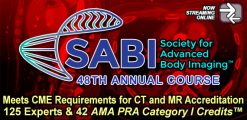
Meetings By Mail Society for Advanced Body Imaging 48th Annual Course 2026
Introduction
The Meetings By Mail Society for Advanced Body Imaging (SABI) 48th Annual Course 2026 delivers an extensive and clinically focused review of modern diagnostic imaging, advanced radiologic interpretation, and emerging technologies shaping the future of body imaging. Developed through Society for Advanced Body Imaging and distributed by Meetings By Mail, the course reflects nearly five decades of educational leadership in abdominal, thoracic, genitourinary, hepatobiliary, and cross-sectional imaging innovation.
Released on April 30, 2026, the program examines contemporary advances in CT, MRI, ultrasound, PET imaging, artificial intelligence integration, structured reporting, oncologic imaging, and multidisciplinary radiology workflows. Through expert-led lectures and clinically oriented imaging discussions, participants gain practical insight into evolving imaging protocols, diagnostic strategies, interpretation pitfalls, workflow optimization, and advanced imaging applications relevant to modern radiology practice.
The curriculum combines academic depth with practical applicability, helping radiologists and imaging specialists strengthen diagnostic accuracy while remaining current with rapidly evolving imaging technologies and clinical guidelines.
Files Included
The SABI 48th Annual Course 2026 educational package includes a large collection of advanced radiology learning materials optimized for flexible review and long-term professional reference.
Included resources:
- 155 video lectures
- 1 downloadable PDF resource
- Total course size: 10.7 GB
- Advanced CT educational sessions
- MRI-focused imaging lectures
- Ultrasound and PET imaging discussions
- Artificial intelligence and workflow optimization content
- Multidisciplinary radiology education modules
- Digital imaging learning resources
These materials support self-paced learning and ongoing review of advanced body imaging techniques and diagnostic interpretation strategies.
Why This Course Is Important
Body imaging continues to evolve rapidly as radiologists integrate advanced MRI protocols, high-resolution CT technologies, functional imaging techniques, structured reporting systems, and artificial intelligence tools into everyday diagnostic workflows. Modern radiologists are increasingly expected to interpret complex multimodality imaging studies while balancing diagnostic precision, workflow efficiency, interdisciplinary communication, and guideline-driven patient care.
At the same time, growing imaging complexity has expanded the need for advanced education in hepatobiliary disease, genitourinary pathology, abdominal imaging, cardiovascular radiology, thoracic imaging, oncologic staging, trauma assessment, and emergency imaging interpretation.
The SABI 48th Annual Course 2026 addresses these demands through a comprehensive educational framework focused on technical innovation, clinical relevance, and practical diagnostic application. The program emphasizes real-world imaging interpretation challenges while exploring how artificial intelligence, updated imaging protocols, and multidisciplinary collaboration are reshaping modern radiology practice.
What Participants Will Learn
Participants completing this course will strengthen their understanding of advanced body imaging techniques, multimodality diagnostic interpretation, and evolving radiologic technologies.
Learning objectives include:
- Evaluating the latest technical advancements and clinical applications in body MRI, CT, and ultrasound
- Applying updated imaging guidelines and standardized protocols for gastrointestinal, genitourinary, and cardiothoracic disease evaluation
- Integrating artificial intelligence and machine learning tools to improve diagnostic accuracy and workflow efficiency
- Recognizing diagnostic pitfalls, imaging artifacts, and complex interpretation challenges in advanced body imaging
- Implementing multidisciplinary imaging strategies for oncology, trauma, and emergency radiology settings
- Reviewing contemporary PET imaging applications and reporting advances
- Understanding innovations in hepatobiliary, pancreatic, renal, abdominal, and thoracic imaging
- Optimizing communication and reporting strategies within multidisciplinary care environments
The curriculum integrates imaging science, clinical interpretation, and workflow-focused education relevant to modern radiology practice.
Full Course Topics & Lectures
CT, MRI & Ultrasound Innovation
Advanced CT Imaging Techniques
Contemporary MRI Applications
Ultrasound Imaging Advances
Multimodality Imaging Integration
Imaging Protocol Optimization
Gastrointestinal Imaging
GI Tract Imaging Updates
Inflammatory Bowel Disease Imaging
Gastrointestinal Oncology Imaging
Emergency Gastrointestinal Imaging
Abdominal Imaging Pitfalls
Genitourinary & Renal Imaging
GU Imaging Techniques
Renal Imaging Advances
Prostate Imaging and MRI
Complex Genitourinary Pathology
Urinary Tract Imaging Challenges
Hepatobiliary & Pancreatic Imaging
Liver Imaging Innovations
Hepatobiliary MRI and CT
Pancreatic Imaging Strategies
Fatty Liver Disease Imaging
Hepatic Lesion Characterization
Cardiovascular & Thoracic Imaging
Cardiothoracic CT Imaging
Thoracic MRI Applications
Cardiovascular Imaging Advances
Pulmonary Imaging Challenges
Cross-Sectional Thoracic Interpretation
OB-GYN & Pelvic Imaging
Female Pelvic MRI
OB-GYN Ultrasound Applications
Gynecologic Oncology Imaging
Advanced Pelvic Imaging Interpretation
Artificial Intelligence & Reporting Innovation
Artificial Intelligence in Radiology
Machine Learning Applications in Imaging
Structured Reporting Advances
Workflow Optimization Strategies
AI-Assisted Diagnostic Interpretation
PET Imaging & Oncology
PET Imaging Applications
Oncologic Imaging Strategies
Tumor Board Imaging Review
Multidisciplinary Cancer Imaging
Professional Development & Practice Management
Radiology Communication Strategies
Diagnostic Error Reduction
Imaging Workflow Efficiency
Practice Development in Advanced Imaging
Future Directions in Body Imaging
Educational Experience & Learning Features
The SABI 48th Annual Course 2026 combines advanced radiology education with practical imaging interpretation strategies designed for modern diagnostic practice.
Educational features include:
- 155 expert-led radiology video lectures
- Advanced CT, MRI, ultrasound, and PET educational sessions
- Multidisciplinary imaging discussions
- Artificial intelligence and workflow optimization reviews
- Contemporary imaging guideline discussions
- Structured reporting and diagnostic communication education
- Oncology and tumor board imaging integration
- Practical imaging interpretation discussions focused on real-world diagnostic challenges
- Digital learning access for flexible self-paced review
The program integrates imaging technology, diagnostic strategy, workflow optimization, and multidisciplinary clinical collaboration into a comprehensive educational experience relevant to contemporary radiology.
Who Should Take This Course
The SABI 48th Annual Course 2026 is intended for physicians and imaging specialists involved in advanced diagnostic radiology and cross-sectional imaging interpretation.
This course is especially valuable for:
- Radiologists
- Body imaging specialists
- Abdominal imaging radiologists
- MRI specialists
- CT imaging specialists
- Ultrasound specialists
- Cardiothoracic imaging physicians
- Oncologic imaging specialists
- Radiology fellows and trainees
- Physicians involved in advanced diagnostic imaging
The curriculum is particularly relevant for clinicians seeking updated education in advanced body MRI, CT, ultrasound, PET imaging, artificial intelligence applications, and multidisciplinary imaging workflows.
Clinical Applications & Practice Benefits
The SABI 48th Annual Course 2026 supports imaging specialists seeking updated diagnostic strategies applicable to both academic and community radiology practice.
Participants gain practical insight into:
- Advanced MRI, CT, ultrasound, and PET imaging interpretation
- Structured reporting and multidisciplinary communication strategies
- Artificial intelligence integration within radiology workflows
- Diagnostic error reduction and imaging artifact recognition
- Complex abdominal, thoracic, hepatobiliary, renal, and pelvic imaging assessment
- Oncology imaging and tumor board collaboration
- Emergency and trauma imaging strategies
- Workflow optimization and reporting efficiency improvements
The educational content strengthens diagnostic reasoning while supporting improved imaging interpretation, reporting quality, and multidisciplinary clinical integration.
Professional Summary
The Meetings By Mail Society for Advanced Body Imaging 48th Annual Course 2026 provides a comprehensive and clinically focused review of advanced diagnostic radiology, body imaging innovation, and multimodality imaging interpretation. Developed through Society for Advanced Body Imaging and distributed by Meetings By Mail, the program delivers advanced educational content relevant to contemporary radiology practice.
From CT and MRI innovation to ultrasound, PET imaging, artificial intelligence, oncologic imaging, reporting advances, and multidisciplinary workflow integration, the course explores the evolving landscape of advanced body imaging through expert-led instruction and clinically practical discussion.
Its integration of modern imaging technologies, diagnostic interpretation strategies, and workflow-focused radiology education makes this course a valuable resource for radiologists and imaging specialists seeking updated expertise in complex body imaging.
.
+ Topics:
| Session 1 – MR Innovations | |
| Quantitative MRI Biomarkers of Diffuse Liver Disease in an Era of Emerging Treatments for MASLD/MASH | Scott Reeder, MD, PhD |
| Measuring Organ, Fat and Muscle Volumes on MRI | Martin Prince, MD, PhD |
| Cutting-edge Solutions for Abdominal DWI | Ryan Brunsing, MD, PhD |
| Shrinking the MRI Protocols: A Consensus Building | Anil Chauhan, MD |
| Abbreviated Body MRI Protocols: Do They Add Value to Healthcare? | Sree Tirumani, MD |
| Panel Discussion | |
| Session 2 – Pancreas | |
| AI in Early Detection of Pancreatic Cancer | Linda Chu, MD |
| Pancreas Cancer Screening and Updated Guidelines for Pancreatic Cyst Management | Avinash Kambadakone, MD, FRCR, FSABI |
| Imaging in Chronic Pancreatitis: Diagnosis, Staging and Management | Frank Miller, MD |
| Novel Treatment Methods for Pancreatic Tumors and Imaging Biomarkers | Desiree Morgan, MD |
| Update on Morphologic and Functional Imaging in Pancreatic NEN Management | Priya Bhosale, MD |
| Panel Discussion | |
| Session 3 – CT Innovations | |
| Breast Imaging Applications of Spectral CT | Richard Ahn, MD, PhD |
| CT-DNA or CT Imaging: Will Radiology Be Obsolete? | John Chang, MD, PhD |
| Getting Started With Photon Counting CT: Consensus for Protocol Development from the SAR PCD ETC | Bari Dane, MD |
| Abdominal CT Technique: Tips & Tricks for Optimization | Corey Jensen, MD |
| Post-Mortem CT: Early Experience | Kalpana Kanal, PhD |
| Panel Discussion | |
| Session 4 – Genitourinary | |
| Prostate: Before and Asfter Intervention | Ali Pirasteh, MD |
| AI in Prostate Imaging and Interpretation | Angela Tong, MD |
| MRI Guided Interventions in Prostate Cancer | Daniel Costa, MD |
| Panel Discussion | |
| Session 5 – Hepatobiliary | |
| Staging and Resectability Assessment of Cholangiocarcinoma Update | Kartik Jhaveri, MD, FRCPC, DABR, FSABI, FSAR |
| The New Cholangiocarcinoma Lexicon | Robert Marks, MD |
| Liver Tranplantation for Cholangiocarcinoma: What the Radiologist Needs to Know | Mustafa Bashir, MD |
| Classification of Ischemic Cholangiopathy in the Era of Machine Perfusion | Motoyo Yano, MD, PhD |
| Inflammatory Imitators: When Bile Duct Disease Mimics Cancer | Atif Zaheer, MD |
| LR-M Category: Challenging LI-RADS Cases | Victoria Chernyak, MD |
| Panel Discussion | |
| Session 6 – Female Pelvis | |
| Role of the Radiologist in the Management of Advanced Ovarian Cancer | Priya Bhosale, MD, MBA |
| Role of Imaging in Fertility Sparing Treatments in Young Women With Gynecological Cancers | Viktoriya Paroder, MD, PhD |
| Staging of Cervical and Uterine Cancer: What Radiologists Need to Know | G. Maia Rauch, MD, PhD |
| Add Value: Laparoscopic and MRI Correlation of Pelvic and Extra-pelvic Endometriosis | Anu Shenoy-Bhangle, MD |
| Top Takeaways for Incidental Adnexal Lesions | Atul Shinagare, MD |
| Panel Discussion | |
| Session 7 – Vanguards | |
| AI and Chronic Liver Disease: a 10 Year Journey | Jonathan Dillman, MD |
| Pelvic Floor Imaging: Putting the Pro in Prolapse Evaluation | Gaurav Khatri, MD |
| Optimized MRI of the Esophagus | Jitka Starekova, MD |
| Rectal Cancer Program | Khartik Jhaveri, MD |
| Session 8 – Artificial Intelligence | |
| AI in Radiology: Legal and Ethical Implications | Anil Chauhan, MD |
| AI: Quality and Safety in Imaging | Subba Digumarthy, MD |
| Use of AI in MSK MRI | Garry Gold, MD |
| Center for High Value Imaging | Scott Reeder, MD, PhD |
| Deep Learning Techniques for Synthetic Image Generation | Andrew Wentland, MD, PhD |
| Panel Discussion | |
| Session 9 – Ultrasound Innovations | |
| Advanced Practice Sonographer: A Solution to Address Increasing Patient Volumes While Improving Exam Quality | Lindsay Akers, RDMS |
| Contrast-Enhanced Ultrasound: A Critical Tool in Your Toolbelt | David Fetzer, MD |
| Ultrasound Imaging of IBD | Jonathan Dillman, MD |
| Session 10 – Gastrointestinal | |
| Imaging of Small Bowel Neuroendocrine Tumor | Priya Bhosale, MD, MBA |
| Crohn’s Disease Strictures: An Update From the SAR IBD DFP | Bari Dane, MD |
| CT Colonography: How to Meet the Future Opportunities and Challenges of Colorectal Cancer Screening | Elizabeth McFarland, MD, FSABI, FACR |
| Rectal Cancer Response Assessment on MRI in the Era of Watch and Wait | Viktoriya Paroder, MD, PhD |
| Imaging Pitfalls in Rectal Cancer – A Case Based Review | Gaiane Maia Rauch, MD, PhD |
| Panel Discussion | |
| Session 11 – Reporting | |
| Radiologist Tools for High Quality Efficient Reporting | Olga Brook, MD, MBA |
| Ethics of Incidental Findings: Relevance to Whole Body MRI Screening of Low-Risk Patients | Matthew Davenport, MD, MBA |
| Radiology Reports – What Comes After the Impression? | Brian Herts, MD |
| Session 12 – Cardiovascular | |
| Lung Cancer: Imaging in the Era of Molecular Diagnostics and Therapy | Subba Digumarthy, MD |
| Interstitial Lung Abnormalities (ILA): Pattern Recognition, Classification and Clinical Implications | Soheil Kooraki, MD |
| Extracellular Volume Fraction and Native T1 Mapping in T2DM Diabetic Cardiomyopathy | Muhammad Umair, MD |
| Panel Discussion | |
| Session 13 – Abdominal | |
| Blind Spot in the Abdomen – MSK Mishaps for the Body Radiologist | Ilana Kafer, MD |
| De Novo Malignancies Related to Solid Organ Transplants | Vikas Kundra, MD, PhD |
| Challenging Bowel Cases | Frank Miller, MD |
| Proliferative Pseudotumors of the Abdomen and Pelvis | Srinivasa Prasad, MD |
| Session 14 – Vibrant Vibes Part I | |
| How Do YOU Define Success? | Tara Catanzano, MD |
| Leadership Challenges in Today’s Healthcare | Anil Chauhan, MD |
| It Takes Us All: Engagement and Meaning At Work | Elizabeth McFarland, MD, FSABI, FACR |
| Standing Out: Creative Strategies for Recruiting and Retaining in a Competitive Hiring Environment | Jordan Perchik, MD |
| Panel Discussion | |
| Session 15 – Vibrant Vibes Part II | |
| Storm Clouds on the Horizon: Political and Economic Trends Affecting Radiology | Erik Paulson, MD |
| Getting the Most Out of Mentoring | Desiree Morgan, MD |
| Leaders in the Early Stage in Radiology: Challenges and Opportunities | Sree Harsha Tirumani, MD |
| Diverse Perspectives on the Challenges of the WRVU System and Potential Solutions | Carolyn Wang, MD |
| Panel Discussion | |
| Session 16 – Rising Stars | |
| Choosing Your Niche as an Early Career Faculty Radiologist: Highlights | Anugayathri Jawahar, MD |
| Breast Imaging Applications of Spectral CT Part 2: Case Based Review | Richard Ahn, MD, PhD |
| Interstitial Lung Abnormality (ILA) Highlights: Pattern Recognition, Classification and Clinical Implications | Soheil Kooraki, MD |
| Facing the Elephant in the Reading Room: Addressing Burnout in Modern Radiology Highlights | Ludovica Lofino, MD |
| Bits to Bedside: Measuring Impact of AI in the HER | Nikhil Madhuripan, MD |
| Panel Discussion | |
| Session 17 – KI-RADS | |
| Kidney Imaging Reporting and Data System (KI-RADS): Initial Steps, Challenges and Opportunities | Jane Wang, Nicole Hindman, MD, Stu Silverman, MD, Matthew Davenport, MD, MBA, Luyao Shen, MD, Ivan Pedrosa, MD, PhD |
| Session 18 – High Value AI | |
| High Value AI Panel Discussion | Angela Tong, MD, Andrew Smith, MD, PhD, Florence Doo, MD, Scott Reeder, MD, PhD, Richard Do, MD, PhD, Garry Gold, MD |
| Session 19 – Tumor Board | |
| Tumor Board: Hepatobiliary | Reve Chahine, MD, Tae-Hyung Kim, MD, Mohammad Ali Ismail, MD, Andrea Siobhan Kierans, MD, Mishal Mendiratta-Lala, MD, Neehar Parikah, MD, Dawn Owen, MD, Adam Yop, MD |
| Session 20 – Don’t Let This Happen To Them Competition | |
| DLTHTT Case #1 | Jay Pahade, MD |
| DLTHTT Case #2 | Brian Herts, MD |
| DLTHTT Case #3 | Farzad Sedaghat, MD |
| DLTHTT Case #4 | Hala Khasawneh, MBBS |
| DLTHTT Case #5 | Ilana Kafer, MD |
| DLTHTT Case #6 | M. Zak Rajput, MD |
| DLTHTT Case #7 | Evan Siegelman, MD |
| DLTHTT Case #8 | Ali Pirasteh, MD |
| DLTHTT Case #9 | Reena Jha, MD |
| Session 21 – Abdominal Workshops | |
| Body MRI in Acute Abdominal Emergencies/Urgencies | Ashlesha Udare, MD, DNB |
| Hydatid Disease of The Abdomen and Its Mimics | Amr Shabana, MD, Ayman Gaballah, MD |
| Artifact Mitigation in Abdominopelvic MRI | Barun Bagga, MBBS, MD, Hersh Chandarana, MD |
| The Peritoneum: Anatomic Models, Pathologic Findings and Spread of Disease | Irfan Kazi, MD, Ayman Gaballah, MD |
| Session 22 – AI Workshops: Clinical Impact | |
| Artificial Intelligence in Thoracic, Cardiac, and Body Imaging | Ramandeep Singh, MD |
| Current Status of Artificial Intelligence in Liver Imaging/LI-RADS | Melina Hosseiny, MD |
| Prostate AI: Current and Future Applications | Angela Tong, MD, Hersh Chandarana, MD, MPH |
| Challenges of AI Implementation in Cardiovascular Imaging: Perspective From Low and Middle Income Countries | Muhammad Umair, MD |
| Session 23 – Chest Imaging Workshops | |
| Case Based Review: Surgical Complications of Diaphragmatic Abnormalities | Sarah Beier, MD |
| Lung Cancer Screening Outcomes: Analysis and Scope for Improvement | Subba Digumarthy, MD |
| Prognostic Value of CMR Parametric Mapping in Cardiac Amyloidosis | Muhammad Umair, MD |
| Session 24 – Professional Opportunities Workshops | |
| Own the Room Before You’re Invited In: Addressing the Leadership Gap | Surbhi Raichandani, MD, Sadhna Nandwana, MD |
| Launching an Internal Moonlighting Program – Our Experience | Mustafa Bashir, MD, Danielle Kruse, MD |
| Pandemic Perils: The Impact on New Graduates and Mechanisms of Support | Tara Catanzano, MD, Beiyi Shen, MD |
| Pathways & Possibilities: Why We Chose Radiology and Why We Stay | Surbhi Raichandani, MD, Ayushi Gupta, MD |
| Mastering Professional Communication in Radiology: Strategies for Clarity and Impact | Asser Abou Elkassem, MD, Andrew Smith, MD, PhD |
| Session 25 – Genitourinary Workshops | |
| A Practical Approach to the Adrenal Incidentaloma | Michael Corwin, MD |
| Atypical GU Tract Infections | Yashant Aswani, MD |
| Adrenal MR: Strengths and Limitations | Frank Miller, MD |
| Genitourinary Tuberculosis | Vikas Kundra, MD, PhD |
| Renal Cell Carcinoma With Tumor Thrombus: What Urologists Want to Know From Imaging | Andrew Wentland, MD, PhD |
| Session 26 – Errors and Incidentalomas Workshops | |
| Oh No, What Did I Miss?! (and how do I deal with it?) | Mahan Mathur, MD, Suzanne Czerniak, MD |
| Living on the Edge: Easy to Fly By Incidental Critical Findings in Body Imaging | Barun Bagga, MBBS, MD, Jay Karajgikar |
| Session 27 – Liver Workshops I: LI-RADS, Neoplasms, Transplant and More | |
| Cirrhotic Liver Imaging Integration With LI-RADS Pre and Post Treatment | Noor Fatima Majeed, MD |
| Liver Neoplasms: Usual and Unusual | Victoria Chernyak, MD, MS |
| MR Approach to Focal Liver Lesions: Characterization by MRI | Evan Siegelman, MD |
| Pre-transplant Liver Imaging and Post-transplant Complications | Milana Flusberg, MD, Ahmed Sobieh, MD, PhD |
| Session 28 – MRI Protocols and Surveillance Workshops | |
| Optimizing MRI Protocols and Volumetric Measurements | Vahid Bazojoo, MD |
| MRI and aMRI Based Surveillance | Bachir Taouli, MD, MHA |
| Session 29 – Women’s Imaging Workshops | |
| MR Evaluation of the Clitoris and Female Perineum: Pearls and Pitfalls in the Imaging of an Understudied Region | Erin Gomez, MD, |
| Multimodality Imaging in Placenta Accreta Spectrum: Current Insights and Future Directions | Neha Yadu, MD |
| Fibroid vs Leiomyosarcoma: Diagnostic Dilemmas and Current Evidence | Nancy Kim, MD, Angela Tong, MD |
| Session 30 – Pancreas Workshops | |
| Imaging of Recurrent Pancreatic Cancer | Mamie Gao, MD, Sanaz Javadi, MD |
| Pancreatic Cancer Postoperative Imaging & Reporting | Eric Tamm, MD, Mindy Wang, MD |
| Session 31 – Pelvis Workshops: Rectal Cancer, Prostate and More | |
| Rectal Cancer – Initial Assessment and Reporting | Kartik Jhaveri, MD |
| Prostate MRI Quality Assessment- PI-QUAL v2 in Practice | Ananya Panda, MD, Pranay Krishnan, MD |
| Synoptic Reporting in Rectal Cancer MRI | Iva Petkovska, MD |
| Perianal and Perilevator Fistulas: Challenges and Disease Specific Considerations | Ahmed Amer, MD |
| Deep Learning Rectal MRI at 0.55T: Early Experience and Challenges | Moozhan Nikpanah, MD, Asser Abou Elkassem, MD |
| Session 32 – Multimodality Perspectives Workshops: PET, Ultrasound and More | |
| PSMA PET for Body Imagers | Ali Pirasteh, MD |
| Complementary Role of Ultrasound in Challenging CT and MRI Cases | Virginia Planz, MD, Krupa Patel-Lipmann, MD |
| Imaging of Lymphedema | Leo Tsai, MD, PhD, Katja De Paepe, MD, PhD |
| Introduction to FES PET/CT | Eric Turner, MD |
| The Advanced Practice Sonographer: Bridging the Gaps Between Needs and Resources in the Modern Academic Department | David Fetzer, MD |
| Session 33 – AI Workshops: Practice Impact | |
| How is AI Changing Radiology Reporting | Joseph Yacoub, MD |
| Precision Education: AI Driven Solution to Address Trainee Knowledge Gaps | Vinay Prabhu, MD, MS, Jay Karajgikar |
| Bits to Bedside: Implementing AI in the EHR | Nikhil Madhuripan, MD |
| Session 34 – Cardiac CT Workshops | |
| Interesting Cardiac CT Case Challenge | Jill Jacobs, MD |
| Talking the Talk: How to Optimally Communicate CCTA Findings to Your Referrers and Patients | Jill Jacobs, MD, |
| CT Evaluation of Coronary Artery Anomalies | Jill Jacobs, MD, MD-HQSM |
| Session 35 – Practice Challenges Workshops | |
| Facing the Elephant in the Reading Room: Addressing Burnout in Modern Radiology | Ludavica Lofino, MD |
| Diverse Perspectives on the Challenges of the Current wRVU Based System and Potential Solutions | Carolyn Wang, MD |
| Barriers to Success: Bias, Burnout and Breaking Through | Surbhi Raichandani, MD, Fatima Majeed, MD |
| Navigating Diversity and Inclusion 2.0: Preserving What’s Important While Maintaining Compliance | Jordan Perchik, MD |
| Microdecision and Decision Making Fatigue – Implications in Life and the Workplace | Tara Catanzano, MD, Agatha Lyczek, MD, PhD |
| Session 36 – Liver Workshops II: Screening and HCC | |
| Post-treatment Imaging of HCC Following Systemic Therapy | Avinash Kambadakone, MD |
| Liver Cancer Screening: an Update on Ultrasound Imaging | David Fetzer, MD |
| Biomarker Based Models for HCC Surveillance | Amit Singal, MD |
| Session 37 – Academics and Research Workshops | |
| In-person Versus Remote Teaching for Radiology Residents and Fellows | Mamie Gao, MD, Sanaz Javadi, MD |
| Choosing Your Niche as an Early Career Faculty Radiologist- Learning From Others’ Experiences | Anugayathri Jawahar, MD, Gillis Schwartz, MD |
| What Journal Editors are Looking for in Submissions- Optimizing Odds for Success | Eric Tamm, MD |