
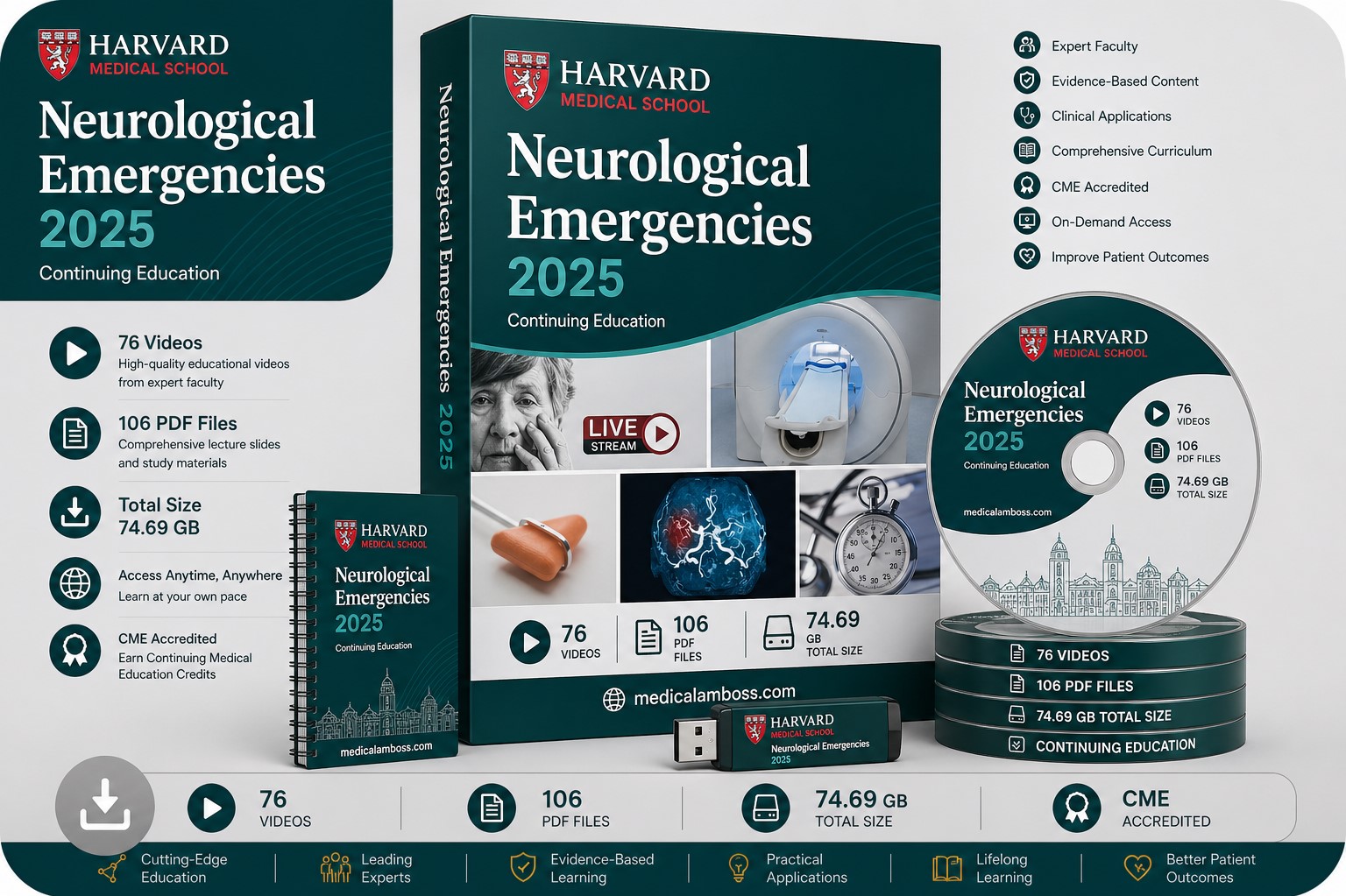
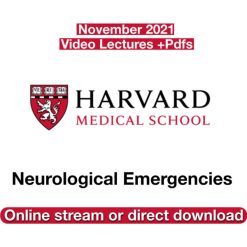
Harvard Neurological Emergencies 2025 (Videos + Slides PDFs)
$95.00
This Product is shared via google drive download link, So please share your correct Gmail id while placing the order .Please note that there are no CME points or certificate associated with this course Samples for Courses Can be found here : Free Samples Here!
+ Include: 76 videos + 106 pdfs, size: 74.69 GB
🧠 Harvard Neurological Emergencies 2025
Evaluation • Diagnosis • Management
📌 Overview
The Harvard Neurological Emergencies 2025 program is an advanced clinical course focused on the rapid recognition, diagnosis, and management of life-threatening neurologic conditions.
Delivered via live streaming (Oct 22–24, 2025), this course equips clinicians with practical, evidence-based strategies to manage neurologic emergencies across emergency, inpatient, and outpatient settings.
Led by expert faculty from Harvard Medical School, Massachusetts General Hospital, and Beth Israel Deaconess Medical Center, the program emphasizes real-world clinical decision-making and early intervention.
🎯 Target Audience
- Emergency medicine physicians
- Neurologists (inpatient & outpatient)
- Internists & hospitalists
- Critical care physicians
- Family medicine & urgent care providers
- Nurse practitioners (NPs) & physician assistants (PAs)
🧠 What You’ll Learn
🚨 Early Recognition & Emergency Evaluation
- Rapid assessment of headache, dizziness, weakness, AMS, and back pain
- Identifying “can’t-miss” neurologic emergencies
- Efficient neurologic exam in busy clinical settings
🧪 Diagnostic Mastery
- When to use CT, CTA, MRI, MRA, and advanced imaging
- Differentiating stroke vs stroke mimics
- Evidence-based evaluation of coma and altered mental status
🧬 High-Risk Neurological Conditions
- Ischemic stroke & TIA
- Intracerebral hemorrhage (ICH)
- Subarachnoid hemorrhage (SAH)
- Traumatic brain injury (TBI)
- Seizures & status epilepticus
- Spinal cord compression & cauda equina syndrome
- Cerebral venous thrombosis (CVT)
- Reversible cerebral vasoconstriction syndrome (RCVS)
💊 Modern Management Strategies
- Thrombolytics & endovascular stroke therapy
- Anticoagulation reversal in ICH/TBI
- Acute seizure management
- Neurocritical care updates
🧓 Special Populations & Risk Management
- Neurologic emergencies in elderly patients
- Pregnancy-related neurologic conditions
- Avoiding misdiagnosis & reducing medical errors
📚 Course Highlights
- 🎥 Real patient video demonstrations for clinical signs
- 🧩 Case-based discussions & breakout sessions
- ⚡ Algorithmic approaches to common presentations
- 🧠 Focus on clinical reasoning and rapid decision-making
- ❓ Interactive Q&A with Harvard faculty
🔑 Key Topics Covered
Day 1
- Neuroimaging fundamentals
- Back pain red flags & spinal emergencies
- Altered mental status & intracerebral hemorrhage
- Functional neurologic disorders
Day 2
- Stroke management (IV thrombolytics & endovascular therapy)
- TIA and subarachnoid hemorrhage
- Seizures, meningitis, and complex headaches
Day 3
- Coma & brain death evaluation
- Dizziness and BPPV
- Traumatic brain injury & concussions
- Diagnostic errors in neurology
🎓 Learning Objectives
By completing this course, participants will:
- Rapidly identify neurologic emergencies
- Apply evidence-based diagnostic algorithms
- Optimize use of imaging and lab testing
- Deliver state-of-the-art emergency management
- Reduce diagnostic errors and improve patient outcomes
⭐ Why This Course Stands Out
- ✔️ Focus on real-life emergency scenarios
- ✔️ Strong emphasis on early action & decision-making
- ✔️ Covers high-yield, high-risk neurologic conditions
- ✔️ Combines theory + clinical application
- ✔️ Ideal for both ED and inpatient clinicians
🚀 Clinical Value
This course provides clinicians with practical tools and updated protocols to manage neurologic emergencies efficiently—helping improve survival, outcomes, and diagnostic accuracy.
Related products
Critical Care - Emergency medicine
Gulfcoast Ultrasound-Guided Upper Extremity Nerve Blocks for Emergency Medicine
Anesthesiology & pain medicine
Critical Care - Emergency medicine
Neurology / neurosurgery courses
Emergency Neurological Life Support -ENLS Live Lecture Series 2021
Neurology / neurosurgery courses
International League Against Epilepsy 14th International Newborn Brain Conference 2023
Neurology / neurosurgery courses
Neurology / neurosurgery courses
2023 SANS Written Boards Review Course for neurological surgeons