ASN Kidney Week Diabetes Management for the Nephrology Care Team 2025
Advanced Diabetes Care in CKD, Dialysis & Kidney Failure
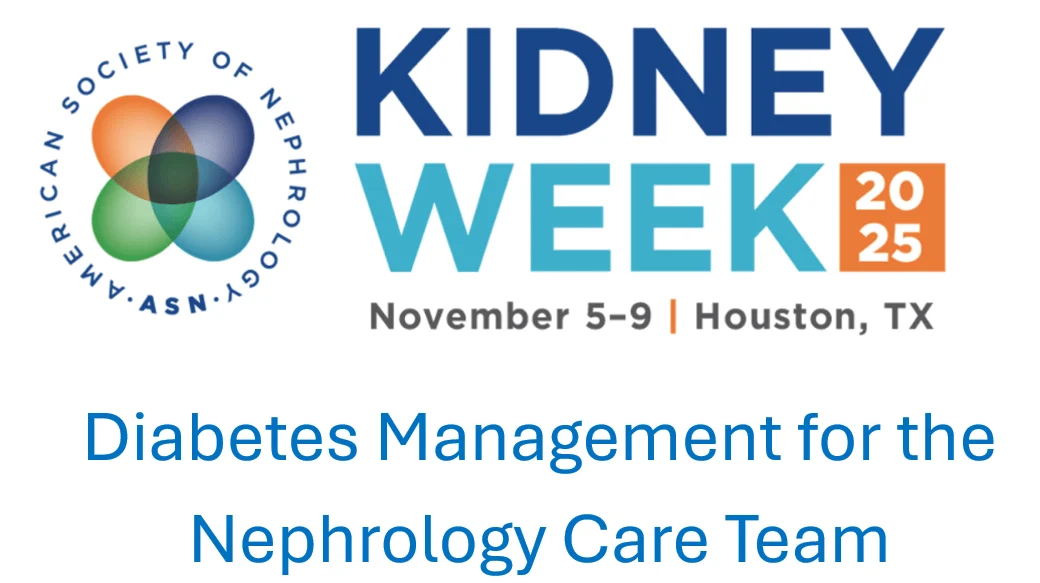
The ASN Kidney Week Diabetes Management for the Nephrology Care Team 2025 program delivers an advanced, clinically practical review of modern diabetes management in patients with chronic kidney disease, dialysis dependence, and kidney transplantation. Developed as a dedicated Early Program before ASN Kidney Week 2025 in Houston, this course focuses on one of the most important transitions occurring in nephrology today: the integration of advanced diabetes technology and next-generation therapeutics into renal care.
As diabetes remains the leading cause of chronic kidney disease worldwide, nephrologists increasingly manage patients whose care now involves:
- Continuous glucose monitoring (CGM)
- Automated insulin delivery systems
- SGLT2 inhibitors
- GLP-1 receptor agonists
- Dual GIP/GLP-1 therapies
- Non-steroidal mineralocorticoid receptor antagonists (nsMRAs)
- Dialysis-related glycemic variability
- Complex metabolic risk management
The course emphasizes that modern diabetic kidney disease management can no longer rely solely on traditional A1c interpretation and standard insulin adjustments. Instead, clinicians must understand rapidly evolving technologies, biomarker limitations, and multidisciplinary treatment strategies tailored specifically to patients with advanced kidney disease.
Course Overview
- Program: Diabetes Management for the Nephrology Care Team
- Event: ASN Kidney Week 2025 Early Program
- Format: Video Lectures
- Location: Houston, Texas
- Focus: Diabetes technology, CKD therapeutics, dialysis glycemic management, and team-based care
Diabetes Management in CKD Is Rapidly Changing
Historically, diabetes management in nephrology often centered on:
- A1c monitoring
- Insulin dose reduction
- Avoidance of hypoglycemia
- Conservative glucose targets
However, advances in both diabetes therapeutics and renal medicine have dramatically changed the treatment landscape.
Today’s nephrology clinicians increasingly encounter:
- CGM data interpretation
- Dialysis-related glucose fluctuations
- Automated insulin pumps
- GLP-1–associated weight reduction
- SGLT2 inhibitor renal protection
- Cardiometabolic risk modification
- Complex polypharmacy management
The symposium repeatedly emphasizes that diabetic kidney disease management is now becoming increasingly individualized, technology-driven, and multidisciplinary.
Continuous Glucose Monitoring in Dialysis Patients
One of the central educational themes throughout the course involves the growing use of continuous glucose monitoring (CGM) in advanced CKD and dialysis populations.
Topics include:
- Ambulatory glucose profile (AGP) interpretation
- Time in Range analysis
- Dialysis-related glucose variability
- Hypoglycemia detection
- CGM limitations in kidney failure
Traditional glycemic assessment becomes particularly difficult in dialysis patients because hemoglobin A1c is often unreliable due to:
- Anemia
- Erythropoietin therapy
- Altered erythrocyte lifespan
- Frequent transfusions
- High red blood cell turnover
The course appropriately explores how CGM may provide a more physiologically accurate understanding of glycemic patterns in patients with kidney failure.
Beyond A1c: Glycated Albumin & Fructosamine
The biomarker-focused sessions review:
- Glycated albumin
- Fructosamine
- Alternative glycemic markers
- Limitations of A1c in CKD
- Biomarker interpretation in dialysis populations
Many nephrologists encounter uncertainty when evaluating glycemic control in patients whose A1c appears deceptively low despite clinically significant hyperglycemia.
The symposium emphasizes that understanding the limitations of traditional biomarkers is now essential in advanced kidney disease management.
Automated Insulin Delivery & Closed-Loop Systems
The program also addresses the rapidly expanding use of automated insulin delivery systems.
Topics include:
- Closed-loop insulin pumps
- Automated insulin delivery mechanics
- Insulin algorithm troubleshooting
- Inpatient pump management
- Dialysis-specific considerations
As more patients adopt advanced diabetes technology, nephrology teams increasingly encounter situations where they must:
- Interpret pump data
- Manage devices during hospitalization
- Coordinate care with endocrinology
- Troubleshoot glucose instability during dialysis
The course appropriately recognizes that many nephrologists were not formally trained in modern diabetes device management despite its growing clinical relevance.
GLP-1 Receptor Agonists & Dual Agonist Therapies
A major portion of the curriculum focuses on newer glucose-lowering and cardiometabolic therapies.
Topics include:
- GLP-1 receptor agonists
- GIP/GLP-1 co-agonists
- Weight management in CKD
- Cardiovascular risk reduction
- Safety in advanced kidney disease
These therapies are increasingly important because they influence far more than glycemic control alone.
The course explores their role in:
- Obesity management
- Cardiovascular protection
- Slowing CKD progression
- Metabolic syndrome treatment
- Transplant patient care
Clinical decision-making becomes especially nuanced in advanced CKD patients due to:
- Gastrointestinal tolerability
- Nutritional concerns
- Volume status considerations
- Medication access barriers
SGLT2 Inhibitors & Kidney Protection
The SGLT2 inhibitor discussions review:
- Renoprotective mechanisms
- CKD progression slowing
- Heart failure reduction
- Advanced CKD implementation
- Practical prescribing considerations
What began as diabetes therapy has now evolved into a foundational component of nephrology care.
The symposium appropriately frames SGLT2 inhibitors not simply as glucose-lowering medications, but rather as:
- Kidney-protective therapies
- Cardiovascular risk modifiers
- Disease-modifying agents in CKD
Non-Steroidal Mineralocorticoid Receptor Antagonists
The course also reviews:
- nsMRAs
- Finerenone-based therapy
- Proteinuria reduction
- Cardiovascular outcomes
- Hyperkalemia management
These discussions reflect the growing movement toward combination cardiorenal-metabolic therapy in diabetic kidney disease.
Diabetes Management in Kidney Transplant Recipients
The transplant-focused sessions explore:
- Post-transplant diabetes management
- Immunosuppression-related metabolic changes
- GLP-1 therapy in transplant recipients
- SGLT2 inhibitor considerations after transplantation
Transplant populations present unique challenges due to:
- Immunosuppressive drug interactions
- Infection risk
- Weight gain after transplantation
- Cardiovascular complications
- Renal graft preservation concerns
Team-Based Care in Nephrology Diabetes Management
One of the strongest themes throughout the symposium is the importance of multidisciplinary care.
The course repeatedly highlights collaboration between:
- Nephrologists
- Endocrinologists
- Pharmacists
- Diabetes educators
- Dialysis nurses
- Advanced practice providers
Modern diabetic kidney disease management increasingly requires coordinated expertise across multiple specialties rather than isolated physician-driven care alone.
Practical Real-World Focus
Unlike purely theoretical endocrinology reviews, this course focuses heavily on practical implementation.
Topics include:
- Medication selection in advanced CKD
- Dialysis glucose variability
- Pump troubleshooting
- CGM interpretation
- Safe prescribing in kidney failure
- Real-world workflow integration
This clinical emphasis makes the material especially relevant for nephrology teams actively managing complex diabetic patients.
What’s Included
- Advanced diabetes management lectures for CKD and dialysis
- CGM and AGP interpretation training
- Automated insulin delivery system reviews
- GLP-1 and SGLT2 inhibitor updates
- Biomarker interpretation discussions
- Dialysis-focused glycemic management strategies
Target Audience
This course is ideal for:
- Nephrologists
- Dialysis physicians
- Endocrinologists managing CKD patients
- Internal medicine physicians
- Diabetes educators
- Pharmacists
- Nurse practitioners
- Physician assistants
- Dialysis unit staff
- Kidney transplant clinicians
Why This ASN Diabetes & Nephrology Course Matters
Diabetes care in nephrology is undergoing a major transformation driven by continuous glucose monitoring, automated insulin delivery systems, advanced cardiorenal therapeutics, and precision metabolic management. Traditional approaches based primarily on hemoglobin A1c and conservative insulin adjustment are rapidly becoming insufficient for modern CKD and dialysis populations.
The ASN Kidney Week Diabetes Management for the Nephrology Care Team 2025 program addresses these changes through a clinically practical and multidisciplinary review of diabetes technology, renal therapeutics, dialysis glycemic assessment, and integrated care strategies. For nephrology professionals seeking updated guidance in modern diabetic kidney disease management, this course offers a highly relevant educational resource grounded in real-world patient care.