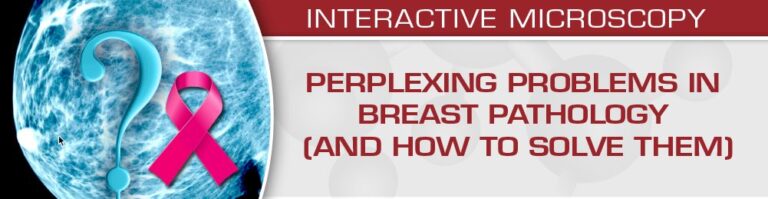
USCAP Perplexing Problems in Breast Pathology (and How to Solve them) 2020


$30.00
This Product is shared via google drive download link, So please share your correct Gmail id while placing the order .Please note that there are no CME points or certificate associated with this course Samples for Courses Can be found here : Free Samples Here!
8 Videos + 8 PDFs

USCAP Perplexing Problems in Breast Pathology (and How to Solve Them) 2020
Advanced Diagnostic Breast Pathology & Immunohistochemistry Review
The USCAP Perplexing Problems in Breast Pathology (and How to Solve Them) 2020 course provides an advanced, case-based review of challenging diagnostic issues encountered in modern breast pathology practice.
Designed to strengthen diagnostic accuracy and improve confidence in difficult breast pathology cases, this educational program explores both common and uncommon benign, in situ, and malignant breast lesions using practical diagnostic strategies relevant to daily surgical pathology practice.
The course emphasizes:
- Breast core needle biopsy interpretation
- Surgical breast pathology
- Differential diagnosis of breast lesions
- Diagnostic pitfalls in breast pathology
- Immunohistochemistry (IHC) applications
- Morphologic pattern recognition
- Challenging benign and malignant breast lesions
Through expert-led discussions and practical diagnostic frameworks, participants learn how to approach perplexing breast pathology cases systematically and efficiently.
🩺 Program Overview
Breast pathology remains one of the most diagnostically complex areas of surgical pathology due to:
- Overlapping morphologic features
- Limited tissue sampling in biopsies
- Variability in lesion appearance
- Immunohistochemical interpretation challenges
- Distinguishing benign from malignant processes
This USCAP course provides practical strategies for resolving these diagnostic dilemmas using:
✔️ Morphologic analysis
✔️ Differential diagnosis frameworks
✔️ Immunohistochemical interpretation
✔️ Correlation with clinical and radiologic findings
✔️ Evidence-based diagnostic criteria
The curriculum is highly focused on real-world pathology practice and difficult daily sign-out scenarios.
🎯 Learning Objectives
Upon completion of this educational activity, participants will be able to:
- Evaluate diagnostic criteria and clinical significance of common and uncommon benign, in situ, and malignant breast lesions
- Recognize differential diagnostic challenges in breast pathology and apply practical problem-solving strategies
- Utilize immunohistochemistry appropriately while understanding its uses and limitations in difficult breast pathology cases
🔬 Benign Breast Lesions & Diagnostic Pitfalls
The course reviews a wide spectrum of benign breast conditions that may mimic malignancy or create diagnostic uncertainty.
Topics include:
- Sclerosing lesions
- Radial scars
- Papillary lesions
- Columnar cell alterations
- Fibroepithelial lesions
- Adenosis variants
- Reactive and inflammatory processes
Faculty emphasize recognition of subtle histologic features that help avoid overdiagnosis and unnecessary treatment.
🧬 In Situ & Malignant Breast Lesions
Advanced discussions focus on:
- Ductal carcinoma in situ (DCIS)
- Lobular neoplasia
- Invasive breast carcinoma
- Special histologic subtypes
- Triple-negative breast lesions
- High-grade malignancies
- Tumor mimickers and unusual presentations
Participants learn structured diagnostic approaches for distinguishing morphologically overlapping lesions.
🩻 Core Needle Biopsy Interpretation
Core needle biopsy interpretation remains a major focus of the program.
Sessions review:
- Limited tissue sampling challenges
- Radiologic-pathologic correlation
- High-risk lesion evaluation
- Upgrade risk assessment
- Management implications of biopsy findings
Faculty provide practical frameworks for handling difficult small-sample breast pathology cases.
🧪 Immunohistochemistry in Breast Pathology
A key strength of the course is its in-depth review of immunohistochemistry (IHC) in breast pathology.
Topics include:
- Appropriate IHC panel selection
- Interpretation pitfalls
- Myoepithelial markers
- Basal and luminal markers
- E-cadherin interpretation
- Hormone receptor evaluation
- Diagnostic limitations of IHC
The course emphasizes using immunohistochemistry as a supportive tool integrated with morphology rather than relying on stains in isolation.
🧠 Differential Diagnosis & Problem Solving
The program is structured around solving difficult diagnostic problems encountered in practice.
Participants develop practical approaches to:
✔️ Challenging morphologic differentials
✔️ Borderline lesions
✔️ Unusual tumor patterns
✔️ Benign mimickers of carcinoma
✔️ Difficult immunophenotypic interpretations
✔️ Core biopsy diagnostic uncertainty
The case-based format helps strengthen diagnostic reasoning and improve confidence in complex breast pathology interpretation.
💡 Key Features
✔️ Advanced breast pathology educational program
✔️ Focus on difficult diagnostic challenges and pitfalls
✔️ Practical differential diagnosis strategies
✔️ Core needle biopsy interpretation review
✔️ Benign, in situ, and malignant breast lesion evaluation
✔️ Comprehensive immunohistochemistry discussion
✔️ Case-based surgical pathology teaching
✔️ Evidence-based diagnostic frameworks
🚀 Why This Course Stands Out
The USCAP Perplexing Problems in Breast Pathology (and How to Solve Them) 2020 course stands out because of its highly practical and problem-oriented approach to breast pathology.
By combining:
- Challenging real-world cases
- Morphologic pattern recognition
- Differential diagnosis strategies
- Immunohistochemistry interpretation
- Practical sign-out guidance
the course helps pathologists strengthen diagnostic precision and confidence in difficult breast pathology cases.
This program serves as a valuable educational resource for surgical pathologists seeking advanced updates in breast pathology diagnosis and immunohistochemical interpretation.
Topics:
- Fibroepithelial Lesions
- Intraductal Proliferative Lesions, Microinvasion, and Columnar Cell Lesions
- Lobular Neoplasia, in situ and Invasive
- Mucinous Lesions and Related Lesions
- Papillary Lesions
- Small Glandular Proliferations and Sclerosing Lesions
- Special Type and Unusual Invasive Cancers
- Spindle Cell Lesions and Vascular Lesions
Related products
Obstetrics & Gynecology
2023 Surgical Pathology Update: Diagnostic Pearls for the Practicing Pathologist: Vol. VII
Obstetrics & Gynecology
USCAP Gynecological Pathology 2022: Essential Knowledge for Diagnostic Practice
Dermatology