
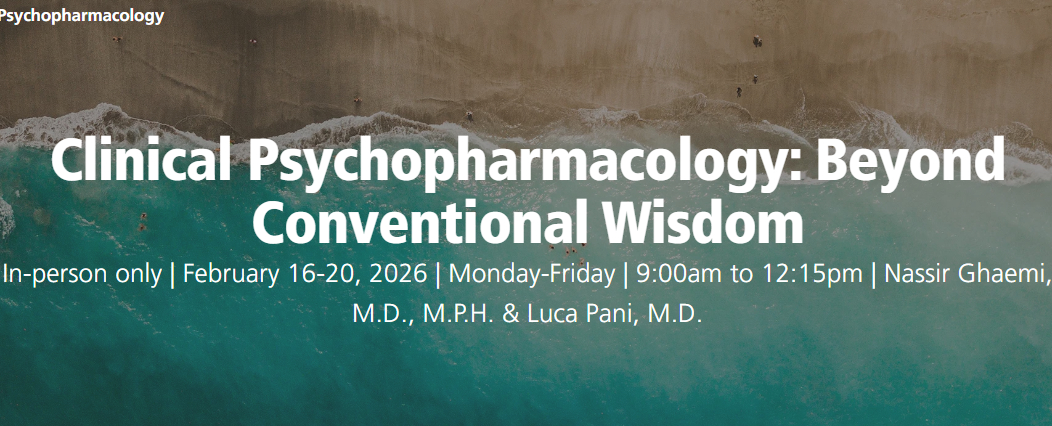
University of Miami Clinical Psychopharmacology Beyond Conventional Wisdom 2026

$15.00
This Product is shared via google drive download link, So please share your correct Gmail id while placing the order .Please note that there are no CME points or certificate associated with this course Samples for Courses Can be found here: Free Samples Here!



🧠 University of Miami Clinical Psychopharmacology: Beyond Conventional Wisdom 2026
Advanced Evidence-Based Psychiatry & Modern Psychopharmacology Strategies
The University of Miami Clinical Psychopharmacology: Beyond Conventional Wisdom 2026 course delivers an advanced, clinically focused exploration of modern psychiatric medication management, diagnostic reasoning, and evidence-based psychopharmacology. Designed to move beyond rigid textbook approaches, this comprehensive program emphasizes real-world clinical outcomes, safety, and practical decision-making in complex psychiatric care.
Held from February 16–20, 2026, the course challenges traditional assumptions in psychiatry by integrating clinical trial evidence, nuanced diagnostic frameworks, and practical treatment strategies for mood disorders, schizophrenia, anxiety, ADHD, and psychopharmacologic safety.
The educational package includes:
- 22 Video Lectures (.MP4)
- 22 Subtitle Files (.VTT)
- 23 PDF Files
- Total Size: 3.08 GB
🧠 Program Overview
Modern psychiatry increasingly recognizes that effective treatment requires more than simply applying DSM diagnostic criteria or memorizing medication mechanisms. Clinicians must integrate:
- Diagnostic precision
- Long-term outcome data
- Safety considerations
- Individual patient variability
- Clinical trial evidence
- Functional outcomes
This advanced psychopharmacology course focuses on practical psychiatric medicine by reviewing:
- Mood disorders and bipolar spectrum illness
- Antidepressant limitations and risks
- Antipsychotic efficacy and safety
- Lithium and mood stabilizer strategies
- ADHD pharmacotherapy
- Anxiety and sleep medications
- Neurobiology versus real-world outcomes
Faculty emphasize how clinicians can improve psychiatric outcomes by moving beyond conventional thinking and applying evidence-driven treatment frameworks to everyday psychiatric practice.
🎯 Learning Objectives
By completing this course, participants will be able to:
✔️ Improve diagnostic precision in psychiatric disorders
✔️ Apply evidence-based psychopharmacology strategies
✔️ Minimize medication-related adverse effects and risks
✔️ Optimize treatment for mood disorders and schizophrenia
✔️ Use clinical trial data to guide medication selection
✔️ Recognize limitations of traditional DSM frameworks
✔️ Manage complex psychopharmacologic side effects
✔️ Develop safer prescribing strategies in psychiatry
📚 What You Will Learn
🔍 Diagnostic Accuracy & Clinical Reasoning
One of the major themes of the course is improving diagnostic accuracy through a more clinically nuanced understanding of psychiatric illness.
Faculty discuss:
- Mood temperaments and psychiatric misdiagnosis
- Bipolar spectrum disorders
- Mixed affective states
- Limitations of rigid DSM categorization
- Practical outcome-focused diagnostic approaches
Participants learn how subtle variations in mood regulation and temperament can dramatically influence:
- Medication response
- Risk of adverse outcomes
- Long-term psychiatric stability
- Treatment selection
The course emphasizes clinically meaningful diagnosis over simplistic symptom labeling.
⚡ Bipolar Disorder & Mood Stabilization
Extensive attention is given to modern bipolar disorder management including:
- Bipolar depression
- Mixed states
- Mania
- Maintenance treatment strategies
Faculty critically review:
- Why antidepressants may fail in bipolar depression
- Dopamine blockade in mood stabilization
- Lithium versus anticonvulsant strategies
- Long-term maintenance considerations
The course explores the evolving evidence supporting lithium as one of the most effective and durable treatments in mood disorders while also reviewing:
- Safety concerns
- Renal considerations
- Monitoring strategies
- Real-world risk assessment
Participants gain practical insight into balancing efficacy with long-term safety in bipolar treatment.
💊 Antidepressants: Efficacy, Risks & Clinical Limitations
The program provides an evidence-based analysis of antidepressant therapy including:
- Acute efficacy
- Maintenance treatment
- Placebo response
- Clinical meaningfulness of effect size
- Withdrawal syndromes
- Cardiovascular risk
- Suicidality concerns
Faculty challenge common assumptions about antidepressants by reviewing:
- Clinical trial data
- Real-world effectiveness
- Limitations in bipolar depression
- Long-term outcome concerns
Participants learn more sophisticated strategies for:
- Patient selection
- Medication choice
- Risk minimization
- Monitoring treatment response
🧩 Schizophrenia & Antipsychotic Therapy
A major section of the course examines modern antipsychotic use in schizophrenia and severe psychiatric illness.
Topics include:
- Short-term symptom reduction
- Long-term functional outcomes
- Receptor pharmacology
- Dose-response relationships
- Adverse effect management
Faculty discuss important safety concerns including:
- Akathisia
- Extrapyramidal symptoms (EPS)
- Tardive dyskinesia
- Neurotoxicity
- Weight gain
- Insulin resistance
- Metabolic syndrome
Participants learn evidence-based approaches to:
- Antipsychotic selection
- Side effect mitigation
- Long-term treatment optimization
- Balancing efficacy and tolerability
⚠️ Medication Safety & Risk Reduction
Psychopharmacologic safety is heavily emphasized throughout the program.
Participants review:
- Lithium nephrotoxicity concerns
- Interpreting renal function and eGFR
- Antidepressant withdrawal syndromes
- Cardiovascular medication risks
- Long-term antipsychotic complications
- Drug interaction principles
Faculty provide practical strategies for safer prescribing while minimizing:
- Polypharmacy complications
- Adverse metabolic outcomes
- Neurological side effects
- Long-term treatment burden
🧬 Neurobiology vs Real-World Clinical Outcomes
One of the most intellectually important aspects of the course examines the disconnect between:
- Neurobiological theories
and - Actual clinical outcomes
The course explains why:
- Mechanistic models do not always predict treatment success
- Receptor pharmacology alone is insufficient
- Clinical trial evidence remains essential
Faculty emphasize outcome-based psychiatry that prioritizes:
- Functional improvement
- Symptom reduction
- Long-term recovery
- Quality of life
- Real-world patient response
This practical framework helps clinicians avoid overreliance on theoretical neurobiology alone.
😴 Anxiety, ADHD & Sleep Pharmacology
Additional modules review:
- Benzodiazepines
- Non-benzodiazepine alternatives
- Sleep medications
- ADHD stimulant therapies
- Amphetamine-based pharmacology
Faculty discuss:
- Safe prescribing principles
- Long-term dependency concerns
- Cognitive and cardiovascular risks
- Balancing efficacy with safety
Participants learn practical strategies for treating:
- Anxiety disorders
- Insomnia
- ADHD
- Comorbid psychiatric presentations
📚 Key Topics Covered
- Bipolar depression and mixed states
- Mood temperaments and psychiatric misdiagnosis
- Lithium versus anticonvulsant mood stabilizers
- Antidepressant efficacy and limitations
- Antidepressant-induced risks and withdrawal
- Schizophrenia treatment outcomes
- Antipsychotic adverse effects and management
- Akathisia, EPS, and tardive dyskinesia
- Metabolic complications of antipsychotics
- ADHD pharmacotherapy
- Neurobiology versus clinical outcomes
- DSM versus non-DSM diagnostic models
- Benzodiazepines and sleep pharmacology
- Psychopharmacology mechanisms and receptor affinity
- Mood stabilizer neurobiology
🚀 Why This Course Stands Out
This University of Miami program stands out because it:
✔️ Prioritizes clinical outcomes over theoretical psychiatry
✔️ Challenges conventional psychiatric assumptions
✔️ Focuses on real-world medication effectiveness
✔️ Provides advanced psychopharmacology insight
✔️ Emphasizes safety and adverse effect reduction
✔️ Integrates clinical trial evidence into practical care
Unlike traditional psychiatry reviews, this course explores:
- Why treatments succeed or fail in practice
- How diagnostic inaccuracies affect outcomes
- The limitations of conventional psychiatric frameworks
- Safer, more individualized prescribing strategies
The result is a highly practical and intellectually rigorous psychopharmacology program for modern psychiatric clinicians.
⭐ Final Perspective
Psychiatric treatment continues to evolve beyond simplistic diagnostic models and mechanism-based medication selection. Effective psychopharmacology now requires nuanced diagnostic reasoning, careful safety evaluation, evidence-based prescribing, and individualized long-term management strategies.
The University of Miami Clinical Psychopharmacology: Beyond Conventional Wisdom 2026 course provides clinicians with a sophisticated and clinically grounded framework for managing mood disorders, schizophrenia, anxiety, ADHD, and complex psychiatric presentations using modern evidence-based psychopharmacology principles.
This advanced educational program is an excellent resource for psychiatrists and mental health professionals seeking to improve medication selection, reduce treatment risks, and optimize real-world psychiatric outcomes.
Related products
Anesthesiology & pain medicine

Internal Medicine

Neurology / neurosurgery courses
SFNP 2023 – French Congress of Peripheral Neuropathy 2023 ( VIDEOS)

Neurology / neurosurgery courses

Neurology / neurosurgery courses
International League Against Epilepsy 14th International Newborn Brain Conference 2023

Neurology / neurosurgery courses

Anesthesiology & pain medicine
Cardiology