
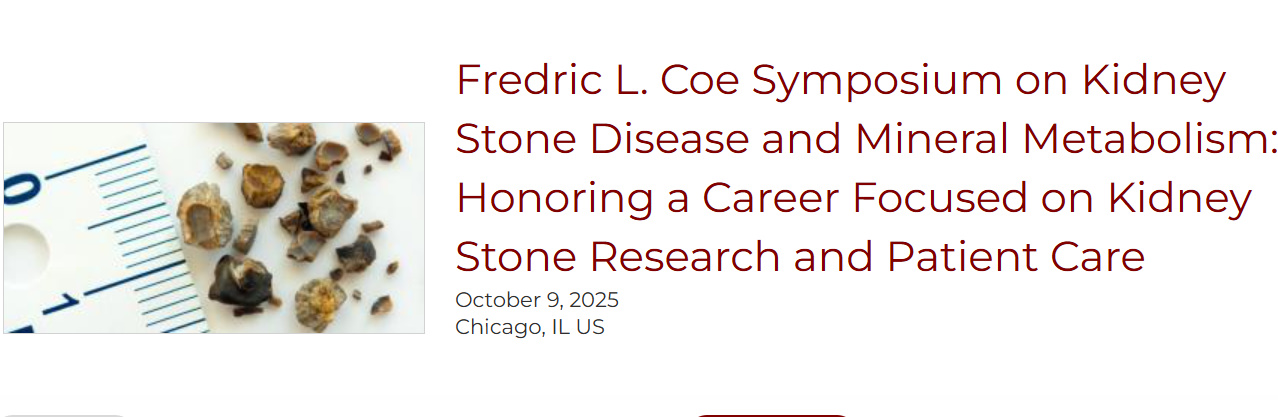
UChicago Medicine Fredric L. Coe Symposium on Kidney Stone Disease and Mineral Metabolism 2025


$10.00
This Product is shared via google drive download link, So please share your correct Gmail id while placing the order .Please note that there are no CME points or certificate associated with this course Samples for Courses Can be found here : Free Samples Here!
UChicago Medicine Fredric L. Coe Symposium on Kidney Stone Disease and Mineral Metabolism 2025
Advanced Nephrolithiasis, Hypercalciuria & Mineral Metabolism Review for Nephrologists and Urologists
The UChicago Medicine Fredric L. Coe Symposium on Kidney Stone Disease and Mineral Metabolism 2025 delivers a highly specialized and clinically focused review of nephrolithiasis, renal mineral handling, and metabolic stone disease. Developed by leading experts in nephrology, urology, and renal physiology, this symposium explores the evolving understanding of kidney stone formation through the lens of mineral metabolism, acid-base physiology, bone health, and urinary biochemical risk factors.
Named in honor of Dr. Fredric L. Coe, whose work substantially shaped modern understanding of calcium stone disease and hypercalciuria, the symposium emphasizes both foundational renal physiology and its practical application in contemporary stone prevention and management.
Rather than approaching nephrolithiasis as an isolated urologic condition, the course frames kidney stone disease as a systemic metabolic disorder involving complex interactions between:
- Calcium metabolism
- Bone turnover
- Urinary chemistry
- Renal tubular physiology
- Acid-base regulation
- Dietary factors
- Genetic susceptibility
This perspective reflects the growing recognition that recurrent nephrolithiasis frequently represents an ongoing metabolic process rather than a purely mechanical problem requiring procedural intervention alone.
Course Details
- 10 Video Lectures (.mp4)
- 10 Audio Files (.mp3)
- 10 Subtitle Files (.vtt)
- 9 Downloadable PDFs
- Total Size: 1.47 GB
- Course Date: October 9, 2025
Kidney Stone Disease as a Metabolic Disorder
One of the most important themes throughout the symposium is the reframing of kidney stone disease as a chronic systemic metabolic condition.
Historically, stone management often focused heavily on:
- Stone extraction
- Surgical intervention
- Acute obstruction management
While these remain critically important, modern nephrolithiasis care increasingly emphasizes:
- Metabolic evaluation
- Stone composition analysis
- Urinary risk profiling
- Dietary intervention
- Long-term recurrence prevention
The symposium repeatedly highlights that recurrent stone formation frequently reflects underlying abnormalities in mineral metabolism and renal physiology that require targeted medical management.
Bone Health, Calcium Handling & Stone Formation
The “Bones and Stones” lecture explores the increasingly recognized relationship between skeletal metabolism and nephrolithiasis.
Topics include:
- Bone mineral density loss
- Calcium homeostasis
- Renal calcium handling
- Hypercalciuria
- Osteopenia and osteoporosis in stone formers
Many clinicians encounter patients with recurrent calcium stones who also demonstrate reduced bone density, raising important questions regarding:
- Calcium mobilization from bone
- Renal calcium wasting
- Vitamin D physiology
- Dietary calcium balance
The course appropriately discusses the clinical challenge of balancing stone prevention strategies with long-term skeletal health preservation.
Kidney Stone Composition Analysis & Clinical Relevance
Stone compositional analysis receives significant attention throughout the symposium.
The lectures examine:
- Calcium oxalate stones
- Brushite stones
- Calcium phosphate stones
- Mixed composition stones
- Crystallization pathways
One recurring issue in clinical practice is that stone composition often provides important clues regarding the underlying metabolic disorder driving recurrence.
Accurate compositional analysis may influence:
- Dietary recommendations
- Pharmacologic therapy
- Urinary alkalinization strategies
- Evaluation for systemic disorders
- Long-term recurrence prevention planning
The symposium emphasizes that stone analysis should not be viewed as a passive laboratory result, but rather as an essential component of precision metabolic stone management.
Idiopathic Hypercalciuria & Papillary Mineral Deposits
Idiopathic hypercalciuria remains one of the central scientific topics discussed throughout the course.
The lectures review:
- Mechanisms of renal calcium wasting
- Papillary mineral deposition
- Randall plaque formation
- Tubular physiology
- Crystal nucleation pathways
Although idiopathic hypercalciuria is commonly encountered, its underlying pathophysiology remains complex and incompletely understood.
The course explores how abnormalities in calcium handling may contribute not only to stone formation, but also to:
- Progressive papillary injury
- Crystal retention
- Recurrent nephrolithiasis
- Bone demineralization
These discussions provide important physiologic context often underemphasized in procedural stone management education.
Acid-Base Physiology & Urinary Stone Risk
Acid-base balance represents another major educational focus of the symposium.
Topics include:
- Urinary acidification
- Urine pH regulation
- Systemic acid-base physiology
- Acid load and stone formation
- Calcium phosphate crystallization
- Citrate metabolism
Clinical decision-making becomes particularly nuanced when managing patients with:
- Low urinary citrate
- Chronic metabolic acidosis
- High urine pH
- Mixed stone compositions
The lectures appropriately emphasize that even relatively subtle disturbances in acid-base homeostasis may substantially alter urinary supersaturation and crystallization risk.
The Brushite Stone Challenge
Brushite stone disease receives dedicated attention through “The Brushite Story” lecture.
Brushite stones remain clinically important because they are frequently associated with:
- High recurrence rates
- Procedural complexity
- Resistance to shockwave lithotripsy
- Metabolic abnormalities
- Progressive stone burden
Many stone specialists recognize brushite disease as one of the more difficult calcium stone phenotypes to manage effectively over time.
The course reviews:
- Brushite pathophysiology
- Urinary risk factors
- Clinical implications
- Prevention strategies
- Challenges in long-term management
The Stone Clinic as a Living Laboratory
One of the more thoughtful aspects of the symposium is its emphasis on longitudinal clinical observation and translational physiology.
The “Stone Clinic as a Living Laboratory” session explores how careful clinical follow-up and metabolic evaluation continue shaping the understanding of nephrolithiasis.
This approach reflects a broader principle within nephrology:
meaningful physiologic insight often emerges directly from detailed patient care and long-term clinical observation.
Integration of Nephrology & Urology Perspectives
A strength of the symposium is its integration of both nephrology and urology viewpoints.
Stone disease management increasingly requires collaboration between:
- Nephrologists
- Endourologists
- Metabolic stone clinics
- Nutrition specialists
- Renal physiologists
The course appropriately bridges procedural and metabolic approaches rather than treating them as separate disciplines.
What’s Included
- 10 expert-led symposium video lectures
- 10 audio recordings (.mp3)
- 10 subtitle files (.vtt)
- 9 downloadable PDF presentations
- Advanced nephrolithiasis physiology review
- Kidney stone prevention and management strategies
- Mineral metabolism and acid-base discussions
Target Audience
This course is ideal for:
- Nephrologists
- Urologists
- Metabolic stone specialists
- Renal fellows
- Urology trainees
- Internal medicine physicians with renal focus
- Clinicians managing recurrent nephrolithiasis
Why This Kidney Stone Symposium Matters
Kidney stone disease continues becoming increasingly recognized as a complex metabolic disorder involving intricate interactions between renal physiology, mineral metabolism, urinary chemistry, and systemic acid-base balance. Successful long-term management now requires far more than episodic stone removal alone.
The UChicago Medicine Fredric L. Coe Symposium on Kidney Stone Disease and Mineral Metabolism 2025 provides a sophisticated and clinically relevant review of these evolving concepts through expert-led discussions grounded in both physiologic research and real-world patient care. For nephrologists and urologists seeking deeper understanding of hypercalciuria, urinary stone risk, mineral metabolism, and evidence-based stone prevention strategies, this symposium offers a highly focused educational resource rooted in modern nephrolithiasis science.
Related products

Critical Care - Emergency medicine

Medical Accounts

Anesthesiology & pain medicine

Internal Medicine

Internal Medicine

Cardiology

Critical Care - Emergency medicine