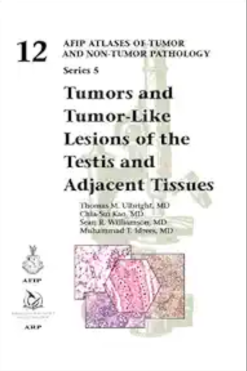
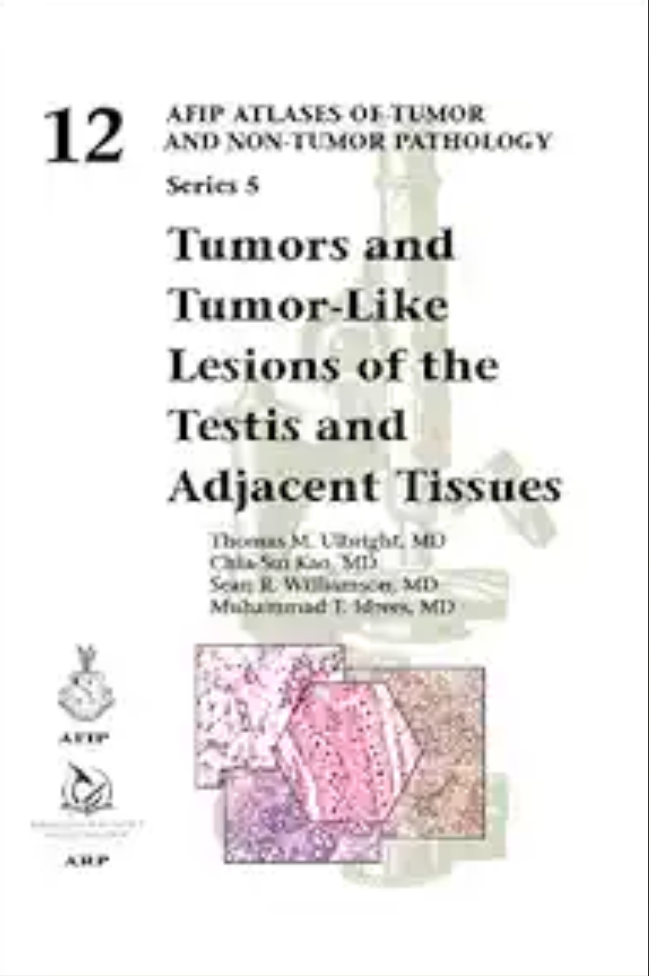
Tumors and Tumor-Like Lesions of the Testis and Adjacent Tissues
AFIP Atlas of Tumor and Non-Tumor Pathology – Series 5, Volume 12 (Original Publisher PDF)
Testicular and paratesticular pathology remains one of the more specialized and diagnostically challenging areas within surgical pathology. Although these lesions are encountered less frequently than tumors in many other organ systems, they often require exceptionally careful morphologic interpretation because diagnostic errors may significantly alter staging, treatment selection, fertility considerations, and long-term oncologic outcomes.
Tumors and Tumor-Like Lesions of the Testis and Adjacent Tissues, part of the renowned AFIP Atlas of Tumor and Non-Tumor Pathology Series 5, provides an in-depth and visually rich reference dedicated to the pathology of testicular, paratesticular, and adjacent scrotal lesions.
Authored by internationally respected genitourinary pathologists T. M. Ulbright and Kao, this volume reflects decades of cumulative consultation experience involving rare tumors, diagnostically difficult lesions, and unusual histologic variants gathered from institutions and pathologists worldwide.
Unlike simplified review texts, this atlas functions as a true diagnostic reference designed for pathologists who require detailed morphologic correlation, differential diagnosis guidance, and practical interpretation strategies in real clinical practice.
Product Details
- Format: Original Publisher PDF
- File Size: 293.2 MB
- Publisher: American Registry of Pathology
- Publication Date: January 1, 2022
- Language: English
- ISBN-10: 1933477229
- ISBN-13: 978-1933477220
Authors:
- T. M. Ulbright
- Kao
Why Testicular Pathology Requires Specialized Expertise
Testicular tumors are relatively uncommon compared with malignancies in many other organ systems, yet they encompass an unusually broad range of:
- Germ cell tumors
- Sex cord-stromal neoplasms
- Lymphoid malignancies
- Mesenchymal lesions
- Metastatic tumors
- Reactive and non-neoplastic mimics
Many lesions display overlapping morphologic features that can make diagnosis particularly difficult, especially in limited biopsies or poorly preserved specimens.
In practice, even experienced surgical pathologists may encounter:
- Rare histologic variants
- Mixed germ cell components
- Mimickers of malignancy
- Treatment-related changes
- Unusual metastatic patterns
- Tumor-like reactive processes
only occasionally.
That limited exposure is precisely why high-quality atlas-based references remain so important in this subspecialty.
The strength of this AFIP volume lies in the extraordinary breadth of cases reviewed by the authors over many years of consultation practice.
Educational & Diagnostic Approach
Morphology-Centered Pathology Interpretation
One of the defining strengths of AFIP fascicles has always been their emphasis on practical morphologic diagnosis rather than simplified summary review.
This volume extensively integrates:
- Gross pathology
- Histologic architecture
- Cytologic detail
- Differential diagnosis
- Ancillary testing
- Clinical correlation
- Immunohistochemistry interpretation
The discussions repeatedly emphasize how diagnostic interpretation evolves through careful pattern recognition rather than isolated reliance on immunostains alone.
This approach is particularly important in testicular pathology because:
- Immunophenotypes may overlap
- Germ cell tumors may show mixed differentiation
- Reactive changes may simulate neoplasia
- Treatment effects may obscure morphology
The atlas consistently addresses these real-world diagnostic pitfalls.
Germ Cell Tumors of the Testis
Germ cell tumors remain the central focus of testicular pathology and represent one of the most clinically important categories reviewed in the atlas.
Coverage includes:
- Seminoma
- Embryonal carcinoma
- Yolk sac tumor
- Choriocarcinoma
- Teratoma
- Mixed germ cell tumors
- Burned-out tumors
- Intratubular germ cell neoplasia
The text carefully explores:
- Morphologic variation
- Histologic overlap
- Staging implications
- Diagnostic mimics
- Immunohistochemical profiles
One recurring challenge in practice involves distinguishing:
- Seminoma from embryonal carcinoma
- Post-treatment fibrosis from residual tumor
- Teratomatous differentiation from somatic transformation
The atlas addresses these distinctions with substantial visual documentation and interpretive commentary.
Tumor-Like Lesions & Diagnostic Mimics
An especially valuable aspect of this volume is its extensive discussion of non-neoplastic and tumor-like lesions that may simulate malignancy.
These include:
- Inflammatory conditions
- Reactive proliferations
- Fibrous pseudotumors
- Vascular lesions
- Stromal hyperplasia
- Atrophic changes
- Treatment-related alterations
In daily practice, one of the greatest risks in testicular pathology involves overdiagnosis of benign or reactive processes as neoplasia.
The atlas repeatedly emphasizes careful clinicopathologic correlation and recognition of subtle morphologic clues that help avoid unnecessary overtreatment.
Sex Cord-Stromal & Rare Testicular Neoplasms
The text also provides detailed coverage of:
- Leydig cell tumors
- Sertoli cell tumors
- Granulosa cell tumors
- Mixed stromal neoplasms
- Rare mesenchymal tumors
- Hematolymphoid malignancies
These lesions are often diagnostically challenging because:
- Many are rare
- Histologic criteria may overlap
- Malignant potential can be difficult to assess
- Limited evidence may guide prognosis
The authors provide nuanced commentary regarding:
- Diagnostic thresholds
- Histologic warning signs
- Clinical behavior
- Ancillary study interpretation
which is particularly valuable for practicing pathologists encountering uncommon cases.
Paratesticular & Adjacent Tissue Pathology
The atlas extends beyond intratesticular lesions to include pathology involving:
- Epididymis
- Spermatic cord
- Tunica vaginalis
- Paratesticular soft tissues
- Scrotal structures
These regions often harbor:
- Mesothelial proliferations
- Sarcomas
- Metastatic disease
- Benign mimics
- Reactive inflammatory lesions
Because these entities are encountered relatively infrequently, detailed reference material becomes especially important when difficult consultation cases arise.
Rich Visual Documentation & Histologic Correlation
As with other AFIP atlas volumes, one of the major strengths of this fascicle is its exceptional image collection.
The book contains extensive:
- Gross pathology photography
- High-resolution histology
- Cytologic correlation
- Variant morphology examples
- Comparative differential images
Visual pattern recognition remains foundational in surgical pathology, particularly in subspecialized areas such as GU pathology where subtle architectural differences may significantly alter diagnosis.
The breadth of illustrated cases substantially enhances the educational value of the text.
Practical Clinical Relevance
Although highly specialized, the atlas remains extremely practical for:
- Surgical pathologists
- GU pathology specialists
- Pathology fellows
- Residents preparing for boards
- Academic consultation services
The text is particularly useful for:
- Difficult consultation cases
- Differential diagnosis review
- Rare tumor interpretation
- Immunohistochemistry correlation
- Board examination preparation
- GU subspecialty training
Because the discussions remain clinically grounded, the book functions effectively both as:
- A day-to-day diagnostic reference
and - An advanced educational resource.
What’s Included
- Original publisher PDF edition
- AFIP Atlas Series 5 Volume 12
- Comprehensive testicular pathology reference
- Germ cell tumor pathology
- Sex cord-stromal neoplasms
- Tumor-like lesions and mimics
- Paratesticular pathology
- Extensive histologic image collection
- Practical differential diagnosis discussions
- Immunohistochemical interpretation guidance
Who Benefits Most From This Atlas
This reference is especially valuable for:
- Surgical pathologists
- GU pathology specialists
- Pathology residents and fellows
- Academic pathology departments
- Oncologic pathology consultation services
- Physicians involved in testicular tumor management
It is particularly useful for clinicians and pathologists seeking:
- Advanced testicular pathology interpretation
- Differential diagnosis guidance
- Rare GU tumor review
- Histologic pattern recognition refinement
- High-quality visual pathology references
Final Expert Perspective
Tumors and Tumor-Like Lesions of the Testis and Adjacent Tissues represents one of the most authoritative modern references available in testicular and paratesticular pathology.
By combining extensive consultation experience, nuanced morphologic interpretation, high-quality histologic imaging, and practical diagnostic guidance, the atlas provides an exceptionally valuable resource for pathologists navigating one of the more specialized and diagnostically challenging areas within genitourinary pathology.
For practicing surgical pathologists, GU pathology fellows, and trainees developing expertise in testicular neoplasia, this AFIP fascicle remains an outstanding reference grounded in real-world diagnostic experience and subspecialty expertise.