
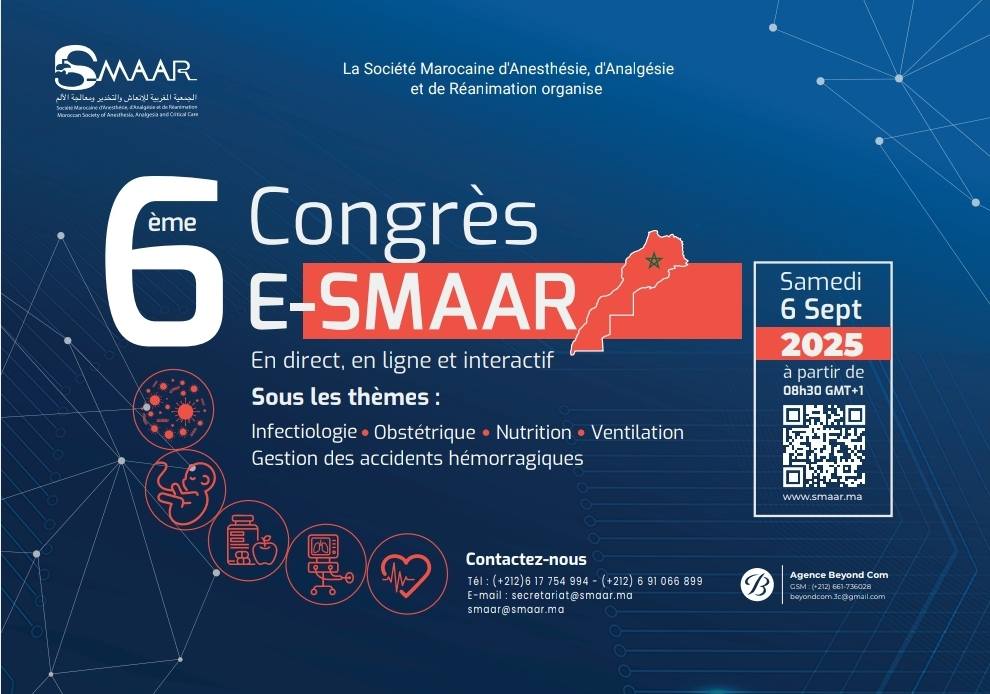
Société Marocaine d’Anesthésie, d’Analgésie et de Réanimation 6 ème Congrès E-SMAAR 2025 French

$20.00
This Product is shared via google drive download link, So please share your correct Gmail id while placing the order .Please note that there are no CME points or certificate associated with this course Samples for Courses Can be found here : Free Samples Here!
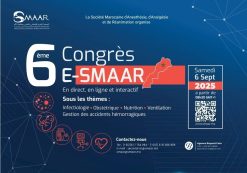
Société Marocaine d’Anesthésie, d’Analgésie et de Réanimation – 6ème Congrès E-SMAAR 2025 (French)
Advanced Updates in Anesthesia, Pain Medicine, and Critical Care
Introduction
Modern anesthesiology has evolved into a highly multidisciplinary specialty that extends far beyond the operating room. Today’s anesthesiologists routinely navigate complex perioperative physiology, advanced airway management, critical care medicine, hemodynamic optimization, regional anesthesia, and acute pain control while simultaneously contributing to broader patient safety initiatives across healthcare systems.
The 6ème Congrès E-SMAAR 2025 from the Société Marocaine d’Anesthésie, d’Analgésie et de Réanimation reflects that expanding clinical landscape through a broad scientific review of contemporary anesthesia, analgesia, and intensive care practice.
Presented entirely in French, this virtual congress gathers specialists in anesthesiology and critical care to discuss evolving perioperative strategies, pharmacologic innovations, monitoring technologies, and evidence-based approaches to patient stabilization in both surgical and ICU settings.
Rather than focusing narrowly on isolated procedures, the program approaches anesthesiology as an integrated specialty deeply connected to perioperative medicine, resuscitation, postoperative recovery, and multidisciplinary critical care.
Clinical Relevance
Perioperative medicine continues to grow increasingly complex as surgical patients become older, more medically fragile, and burdened by multiple chronic comorbidities.
Anesthesiologists now routinely manage patients with:
- advanced cardiovascular disease
- obesity
- respiratory compromise
- renal dysfunction
- frailty syndromes
- polypharmacy
- difficult airway anatomy
- postoperative critical illness
At the same time, intensive care units continue to face resource strain, workforce limitations, and rapidly evolving therapeutic protocols.
The congress addresses these realities through discussions centered on:
- perioperative safety
- hemodynamic optimization
- multimodal analgesia
- ICU monitoring
- respiratory support
- prevention of perioperative complications
- postoperative recovery pathways
One recurring challenge in modern anesthesia involves balancing increasingly aggressive surgical interventions against physiologic reserve. Clinical decision-making often becomes particularly nuanced in elderly patients, critically ill populations, or individuals with substantial cardiopulmonary disease.
The congress emphasizes practical strategies for improving patient outcomes while reducing perioperative morbidity and enhancing recovery.
Educational Approach
Multidisciplinary Perioperative Perspective
The educational structure reflects the interconnected nature of anesthesia and critical care medicine.
Rather than presenting anesthesia as a purely technical specialty, the congress integrates discussions involving:
- perioperative physiology
- ICU medicine
- pain management
- postoperative monitoring
- pharmacology
- respiratory care
- patient safety systems
This broader framework feels particularly relevant because modern anesthesiologists frequently function as perioperative physicians coordinating care across multiple clinical environments.
The sessions also emphasize evidence-based protocols while still acknowledging the variability and uncertainty that often exists in real-world clinical practice.
In practice, anesthetic management is rarely protocol-driven alone. Patient-specific physiology, surgical complexity, institutional resources, and intraoperative instability frequently require individualized judgment and rapid adaptation.
Key Learning Areas
Advances in General and Regional Anesthesia
The congress reviews contemporary developments in both general and locoregional anesthesia techniques.
Topics include:
- anesthetic pharmacology
- balanced anesthesia strategies
- ultrasound-guided regional anesthesia
- perioperative monitoring
- airway management
- hemodynamic stabilization
- enhanced recovery protocols
Particular emphasis is placed on improving perioperative safety while minimizing postoperative complications and facilitating faster patient recovery.
Modern anesthesia increasingly prioritizes precision rather than simply achieving unconsciousness. Small adjustments in fluid management, analgesic selection, ventilation strategy, or vasoactive support may significantly influence postoperative outcomes.
Pain Medicine & Analgesia
Pain management remains a central theme throughout the congress.
Discussions explore:
- acute postoperative pain
- chronic pain management
- multimodal analgesia
- opioid-sparing strategies
- regional analgesic techniques
- perioperative pain protocols
One important clinical challenge involves balancing effective analgesia against the risks of oversedation, respiratory depression, prolonged hospitalization, and opioid-related adverse effects.
The congress highlights evolving multimodal approaches that integrate regional anesthesia, non-opioid pharmacology, and individualized analgesic planning.
Critical Care & Intensive Care Medicine
Critical care medicine forms a major component of the scientific program.
Sessions examine:
- ICU monitoring
- respiratory support
- shock management
- sepsis care
- organ support strategies
- perioperative critical illness
- multidisciplinary ICU coordination
For anesthesiologist-intensivists, the overlap between operating room physiology and ICU medicine is increasingly important. Hemodynamic instability, ventilation management, and organ dysfunction often begin intraoperatively and continue throughout postoperative critical care.
The congress reflects this continuity between perioperative and intensive care medicine particularly well.
Perioperative Complication Prevention
A substantial focus is placed on identifying and reducing perioperative complications.
Topics include:
- perioperative cardiovascular events
- respiratory complications
- thromboembolic risk
- postoperative delirium
- difficult airway scenarios
- rapid recovery pathways
- patient safety optimization
Clinical outcomes are increasingly influenced not only by surgical success, but also by how effectively perioperative complications are anticipated and prevented.
Many anesthesiologists encounter situations where proactive physiologic optimization becomes more important than reactive crisis management alone.
Real-World Practical Applications
Operating Room Decision-Making
The congress provides clinically useful perspectives for:
- anesthetic planning
- airway strategy selection
- intraoperative monitoring
- fluid management
- postoperative analgesia
- perioperative risk assessment
These discussions are especially valuable in complex surgical populations where small physiologic changes may rapidly destabilize critically ill patients.
ICU and Postoperative Care Integration
For physicians practicing both anesthesia and critical care medicine, the program reinforces the integration between:
- operative management
- postoperative stabilization
- ICU transition
- long-term recovery planning
This integrated perioperative model increasingly defines modern anesthesiology practice worldwide.
Evidence-Based Perioperative Protocols
The congress also emphasizes standardized approaches aimed at:
- improving patient safety
- reducing variability
- accelerating recovery
- minimizing complications
- enhancing multidisciplinary communication
While evidence-based frameworks are important, the sessions also acknowledge that clinical judgment remains essential when protocols conflict with real-world patient physiology.
Who Benefits Most
This congress is particularly valuable for:
- anesthesiologists
- intensivists
- critical care physicians
- perioperative medicine specialists
- anesthesia residents
- ICU physicians
- acute pain specialists
- physicians involved in surgical critical care
French-speaking clinicians seeking updates in anesthesia and intensive care medicine will likely find the content especially relevant.
Frequently Asked Questions
Is this congress presented in English?
No. The entire program is presented in French.
Does the course focus only on anesthesia techniques?
No. The congress also covers critical care medicine, pain management, perioperative safety, and ICU-related topics.
Are regional anesthesia and pain medicine discussed?
Yes. The program includes discussions on locoregional anesthesia, multimodal analgesia, and perioperative pain management strategies.
Is the content relevant for intensivists?
Absolutely. Critical care medicine and perioperative ICU management are major components of the congress.
Does the congress include practical perioperative management topics?
Yes. The sessions emphasize real-world perioperative decision-making, complication prevention, hemodynamic management, and patient safety protocols.
Final Expert Perspective
The 6ème Congrès E-SMAAR 2025 reflects the increasingly sophisticated role anesthesiologists now play across perioperative medicine, pain management, and critical care.
Its strength lies in connecting anesthesia practice with broader physiologic management, postoperative recovery, and multidisciplinary ICU care rather than limiting discussion to technical anesthetic procedures alone.
For French-speaking anesthesiologists and intensivists seeking clinically grounded updates in perioperative medicine, analgesia, and critical care, the congress provides a thoughtful overview of the evolving challenges shaping modern anesthesia practice.
Related products
Anesthesiology & pain medicine
Anesthesiology & pain medicine
Critical Care Symposium: Mastering ED Mechanical Ventilation
Anesthesiology & pain medicine
GULFCOAST Introduction to Ultrasound-Guided Regional Anesthesia 2019
Anesthesiology & pain medicine
Gulfcoast Ultrasound-Guided Regional Anesthesia : Upper Extremities

Anesthesiology & pain medicine
Dannemiller Updates On Pain Review: Conversations with the Experts 2022
Anesthesiology & pain medicine
Anesthesiology & pain medicine
Anesthesiology & pain medicine