
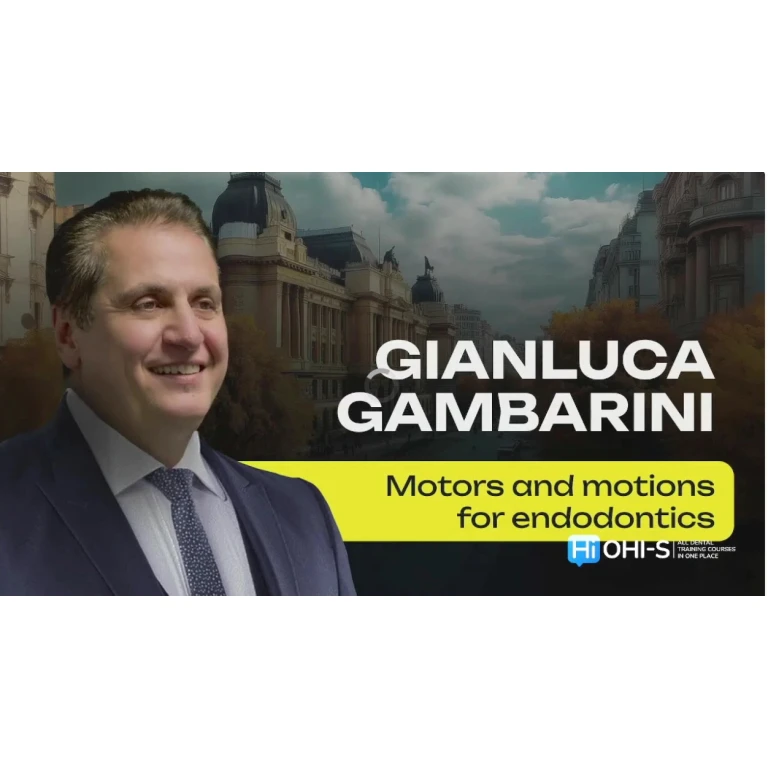
OHIS Motors and Motion in Endodontics with NiTi Technologies

$20.00
This Product is shared via google drive download link, So please share your correct Gmail id while placing the order .Please note that there are no CME points or certificate associated with this course Smples for Courses Can be found here : Free Samples Here!
3 lessons (2h 31min)



OHIS Motors and Motion in Endodontics with NiTi Technologies
Advanced Rotary and Reciprocating Endodontic Instrumentation with Modern NiTi Systems
Introduction
Contemporary endodontics has shifted dramatically toward minimally invasive canal shaping, enhanced visualization, and biomechanically safer instrumentation strategies. The evolution of nickel-titanium (NiTi) technology has played a central role in that transformation, allowing clinicians to negotiate increasingly complex canal anatomies while reducing procedural errors that historically compromised long-term treatment success.
OHI-S Motors and Motion in Endodontics with NiTi Technologies explores these developments through a focused review of modern instrumentation systems, rotary and reciprocating mechanics, hybrid motion strategies, and updated endodontic treatment protocols presented by Gianluca Gambarini.
Rather than treating endodontic instrumentation as a purely mechanical process, the course emphasizes the interaction between:
- canal anatomy
- file metallurgy
- motion dynamics
- stress distribution
- irrigation effectiveness
- biologic preservation
This broader perspective is increasingly important because successful root canal therapy depends not only on shaping canals efficiently, but on preserving dentin integrity while minimizing procedural complications.
Clinical Relevance
Modern root canal treatment presents a constant balance between effective debridement and structural preservation.
Many clinicians encounter difficult cases involving:
- severe canal curvature
- calcified anatomy
- narrow canals
- retreatment scenarios
- separated instruments
- transportation risk
- ledging
- apical perforation
The introduction of heat-treated NiTi systems has significantly improved flexibility and fracture resistance, but instrumentation safety still depends heavily on motion strategy, torque control, canal anatomy interpretation, and operator technique.
One recurring challenge in endodontics involves minimizing iatrogenic damage during instrumentation while still achieving adequate cleaning and shaping.
This course addresses that challenge directly through discussions of:
- hybridized motion systems
- reciprocation strategies
- low-stress instrumentation
- minimally invasive shaping
- optimized irrigation protocols
Clinical decision-making becomes particularly nuanced in curved canals where aggressive shaping may improve irrigation access but simultaneously weaken root structure or increase procedural risk.
Educational Approach
Biomechanics-Driven Endodontic Training
The course combines:
- instrumentation theory
- metallurgy concepts
- motion analysis
- clinical case review
- retreatment protocols
- irrigation strategy
Rather than presenting isolated file systems as interchangeable tools, the educational framework focuses on how motion mechanics and instrument design influence:
- cutting efficiency
- torsional stress
- cyclic fatigue
- dentin preservation
- procedural safety
This approach feels clinically realistic because modern endodontic success increasingly depends on understanding the behavior of instruments inside complex root canal systems rather than simply memorizing file sequences.
The lectures also maintain a practical tone by discussing the limitations and risks associated with different instrumentation philosophies rather than promoting a single rigid system.
Key Learning Areas
NiTi Instrument Selection & Heat-Treated Systems
A major focus of the course involves understanding the clinical behavior of modern NiTi instruments.
Topics include:
- heat-treated NiTi metallurgy
- file flexibility
- cyclic fatigue resistance
- torsional behavior
- curved canal management
- instrument selection criteria
The discussion of hybrid heat treatment techniques is particularly relevant because thermal processing has become one of the defining advancements in contemporary endodontic file design.
In practice, improved flexibility allows clinicians to better preserve original canal anatomy while reducing transportation risk in highly curved roots.
However, the course also emphasizes that increased flexibility alone does not eliminate the need for careful instrumentation strategy and tactile control.
Rotary vs Reciprocating Motion
The second major educational theme centers on endodontic motor dynamics and motion systems.
Topics include:
- rotary instrumentation
- reciprocating systems
- combined motion concepts
- hybrid motion protocols
- stress reduction strategies
- instrumentation efficiency
One of the more interesting aspects of the course is its discussion of “hybridizing motions” rather than treating rotary and reciprocation systems as mutually exclusive philosophies.
This reflects a broader trend in endodontics where clinicians increasingly adapt motion strategies according to canal anatomy, instrument design, and procedural goals rather than relying exclusively on one approach.
Minimally Invasive Canal Shaping
The course repeatedly reinforces minimally invasive instrumentation concepts.
Discussions include:
- dentin preservation
- low-stress shaping
- prevention of iatrogenic errors
- conservative enlargement
- shaping efficiency
- canal centering ability
One recurring issue in modern endodontics is that over-instrumentation may improve canal access temporarily while weakening long-term root integrity.
The program emphasizes that effective endodontic treatment depends on balancing:
- cleaning efficacy
- irrigation penetration
- structural preservation
- obturation predictability
This biologically conservative philosophy aligns closely with current trends in restorative-endodontic integration.
Irrigation & Canal Cleanliness
Instrumentation alone cannot fully disinfect root canal systems, and the course appropriately devotes attention to irrigation protocols and cleanliness assessment.
Topics include:
- irrigation strategies
- canal cleanliness evaluation
- EndoCator utilization
- debris management
- retreatment irrigation protocols
In contemporary endodontics, clinicians increasingly recognize that shaping and irrigation must function as an integrated biologic system rather than separate procedural steps.
The discussions surrounding canal cleanliness are especially useful because mechanical enlargement alone rarely eliminates microbial complexity within lateral anatomy and dentinal tubules.
Retreatment & Obturation Protocols
The course also reviews:
- retreatment protocols
- single-file reciprocation
- obturation techniques
- shaping optimization
- stress-minimizing instrumentation methods
Retreatment cases often present substantially higher technical difficulty due to:
- altered anatomy
- previous procedural errors
- canal obstruction
- residual filling materials
- structural compromise
The retreatment discussions therefore add practical clinical depth beyond routine primary endodontic workflows.
Real-World Practical Applications
Complex Curved Canal Management
The course provides clinically relevant guidance for:
- negotiating curved canals
- reducing transportation
- minimizing ledging risk
- improving file longevity
- preserving canal anatomy
These concepts are particularly important for molar endodontics where curvature complexity frequently determines procedural difficulty.
Safer Instrumentation Strategies
Clinicians performing rotary endodontics will likely benefit from the discussions surrounding:
- stress reduction
- instrument fatigue
- combined motion systems
- torque management
- conservative shaping
Many procedural complications originate not from file defects alone, but from excessive mechanical stress within anatomically restricted canals.
Contemporary Endodontic Workflow Integration
The broader educational message throughout the course is that successful endodontics increasingly depends on integrating:
- digital visualization
- motion control
- advanced metallurgy
- irrigation science
- biologically conservative shaping
This systems-based perspective reflects the direction modern endodontic practice continues to evolve.
Who Benefits Most
This course is especially valuable for:
- endodontists
- restorative dentists
- general dentists performing root canal therapy
- clinicians using rotary instrumentation systems
- dentists interested in minimally invasive endodontics
The material is particularly useful for practitioners managing complex molar anatomy and curved canal systems.
Frequently Asked Questions
Does the course focus heavily on NiTi instrumentation?
Yes. NiTi metallurgy, heat-treated systems, flexibility, and instrumentation mechanics form central components of the course.
Are rotary and reciprocating systems both discussed?
Absolutely. The course compares rotary, reciprocating, and combined motion approaches in modern endodontics.
Does the course cover retreatment cases?
Yes. Specific protocols for retreatment instrumentation and canal management are included.
Is irrigation discussed in detail?
Yes. Irrigation protocols, canal cleanliness, and the EndoCator system are reviewed as part of integrated endodontic treatment.
Is the content suitable for general dentists?
Yes. General dentists performing endodontic procedures will likely find the material clinically applicable, particularly those using rotary NiTi systems.
Final Expert Perspective
OHI-S Motors and Motion in Endodontics with NiTi Technologies offers a thoughtful exploration of how modern instrumentation science continues to reshape root canal therapy.
Its greatest strength lies in connecting metallurgy, motion mechanics, minimally invasive shaping, and biologic treatment principles into a clinically coherent framework rather than presenting instrumentation as a purely mechanical process.
For clinicians seeking a deeper understanding of contemporary NiTi systems, hybrid motion protocols, and safer canal shaping strategies, the course provides a highly practical and scientifically grounded review of modern endodontic instrumentation philosophy.
Related products



Anesthesiology & pain medicine
DENTAL