
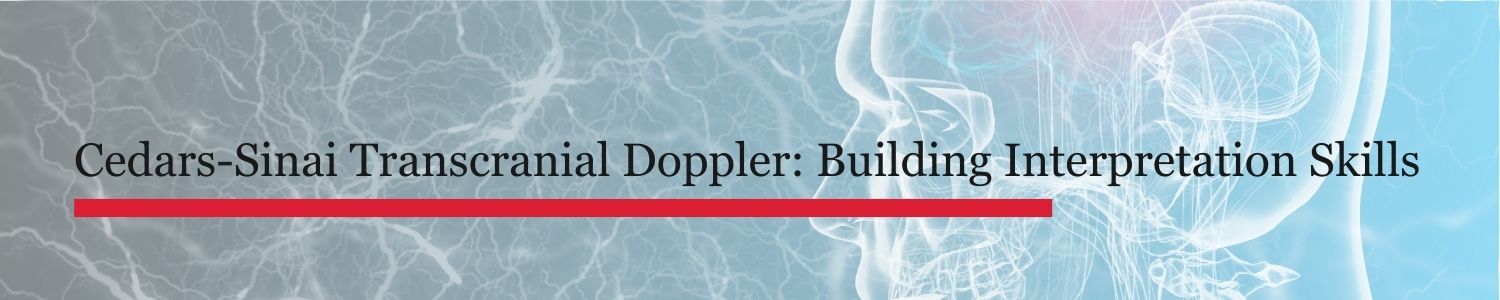
Cedars-Sinai Transcranial Doppler: Building Interpretation Skills – March 2026

$50.00
This Product is shared via google drive download link, So please share your correct Gmail id while placing the order .Please note that there are no CME points or certificate associated with this course Samples for Courses Can be found here : Free Samples Here!


Cedars-Sinai Transcranial Doppler: Building Interpretation Skills – March 2026
Practical Training in Transcranial Doppler Interpretation & Cerebrovascular Hemodynamics
The Cedars-Sinai Transcranial Doppler: Building Interpretation Skills – March 2026 course provides focused, practical education in the interpretation and clinical application of Transcranial Doppler (TCD) ultrasound for cerebrovascular and neurocritical care practice. This expert-led online program strengthens both foundational and advanced interpretation skills required for evaluating cerebral blood flow, waveform morphology, collateral circulation, vasospasm, and intracranial vascular pathology.
This educational package includes 2 video recordings + 3 PDF resources with a total size of 1.72 GB and delivers evidence-based neurovascular ultrasound instruction using real-world case analysis and guideline-driven interpretation techniques.
🩺 Program Overview
Transcranial Doppler ultrasound remains one of the most valuable bedside neurovascular tools for evaluating:
- Cerebral hemodynamics
- Intracranial stenosis
- Occlusion and collateral flow
- Cerebral vasospasm
- Circulatory arrest
- Embolic monitoring
- Vasomotor reactivity
- Right-to-left shunting
This Cedars-Sinai course offers structured training in:
- TCD waveform interpretation
- Diagnostic criteria application
- Cerebrovascular flow analysis
- Neurovascular ultrasound reporting
- Technical scanning optimization
Participants review supervised TCD studies in an open educational environment led by experienced neurosonology faculty.
The course also supports clinicians preparing for:
- ASN Neurosonology examination requirements
- Advanced neurovascular ultrasound interpretation
- Stroke monitoring applications
🎯 Key Features
✔️ Practical transcranial Doppler interpretation training
✔️ Evidence-based cerebrovascular ultrasound education
✔️ Interactive case-based learning
✔️ Waveform morphology and hemodynamic analysis
✔️ Stroke and vasospasm monitoring applications
✔️ Bubble study interpretation training
✔️ Neurocritical care ultrasound applications
✔️ Technical scanning tips and troubleshooting
✔️ Reporting terminology and documentation guidance
📚 What You Will Learn
🧠 Fundamentals of Transcranial Doppler Ultrasound
Participants will develop a strong foundation in:
- Principles of TCD ultrasound
- Cerebrovascular hemodynamics
- Circle of Willis anatomy
- Acoustic windows and insonation techniques
- Technical limitations of TCD
- Flow velocity interpretation
Faculty explain how physiologic and pathologic changes alter waveform morphology and blood flow dynamics.
🌊 Normal & Abnormal Waveform Interpretation
A major focus of the course is recognizing:
- Normal intracranial flow patterns
- Diseased waveform morphology
- Hemodynamic abnormalities
- Hyperdynamic states
- Pathological velocity changes
Participants learn practical interpretation strategies for:
- Healthy studies
- Abnormal cerebrovascular findings
- Compensatory collateral circulation
- Hemodynamic flow redistribution
The course emphasizes interpretation confidence through repeated case-based review.
🧬 Stenosis, Occlusion & Collateral Flow
Advanced sessions focus on:
- Intracranial stenosis interpretation
- Occlusion detection
- Collateral flow analysis
- Flow pattern recognition
- Cerebrovascular compensation mechanisms
Clinicians learn how to identify:
- MCA stenosis
- ICA occlusion patterns
- Cross-flow through the Circle of Willis
- Secondary collateral pathways
These sessions are highly applicable to modern stroke and cerebrovascular care.
🚨 Vasospasm & Neurocritical Care Applications
Dedicated neurocritical care lectures review:
- Vasospasm monitoring after SAH
- Cerebral blood flow monitoring
- Lindegaard ratio interpretation
- ICU neurosonology applications
- Neurovascular emergency assessment
Participants learn practical approaches for integrating TCD into critical care and stroke monitoring workflows.
🫧 Bubble Studies & Specialized Applications
Specialized neurovascular applications include:
- Bubble study protocols
- Detection of right-to-left shunts
- PFO screening techniques
- Vasomotor reactivity testing
- Sickle cell disease monitoring
The course reviews:
- Contrast administration methods
- Microembolic signal interpretation
- Cerebrovascular reserve assessment
- Advanced monitoring techniques
⚙️ Technical Skills & Reporting
Practical scanning instruction includes:
- Probe positioning
- Acoustic window optimization
- Technical troubleshooting
- Improving waveform acquisition
- Reporting terminology
- Quality assurance strategies
Faculty also share:
- Technical tricks and scanning pearls
- Documentation recommendations
- Interpretation workflow optimization
These sessions help clinicians improve both technical performance and reporting accuracy.
🎥 Included Sessions
Day 1
- Welcome and Course Introduction
- Normal Studies and Acoustic Limitations
- Stenosis, Occlusion, and Collateral Flow Patterns
- Technical Tricks and Tips
- Monitoring: Guidelines, Criteria, and Case Studies
Day 2
- Bubble Studies: Guidelines, Criteria, and Case Studies
- Vasospasm: Guidelines, Criteria, and Case Studies
- Technical Tricks and Tips
- Circulatory Arrest: Guidelines, Criteria, and Case Studies
- Vasomotor Reactivity and Sickle Cell Studies
- Closing Remarks
🚀 Why This Course Stands Out
This Cedars-Sinai neurosonology program is distinguished by its:
- Strong emphasis on practical TCD interpretation
- Case-based cerebrovascular learning approach
- Real-world inpatient and outpatient applications
- Evidence-based diagnostic criteria
- Comprehensive neurovascular waveform analysis
- Focus on technical and reporting excellence
Unlike purely theoretical ultrasound programs, this course is specifically designed to improve:
- Interpretation confidence
- Diagnostic accuracy
- Technical scanning skills
- Neurovascular clinical decision-making
The program provides a highly practical framework for mastering modern transcranial Doppler interpretation.
⭐ Final Perspective
As cerebrovascular medicine and neurocritical care continue to evolve, accurate interpretation of transcranial Doppler ultrasound has become increasingly important in stroke management, vasospasm monitoring, emboli detection, and cerebral hemodynamic assessment.
The Cedars-Sinai Transcranial Doppler: Building Interpretation Skills – March 2026 course offers a comprehensive, case-based approach to mastering TCD interpretation using expert instruction, evidence-based guidelines, and real-world neurovascular applications. It is an outstanding educational resource for clinicians seeking to improve their expertise in neurosonology and cerebrovascular ultrasound practice.
Related products
Critical Care - Emergency medicine
2022 UPDATES IN THERAPEUTICS: CRITICAL CARE PHARMACY PREPARATORY REVIEW AND RECERTIFICATION COURSE
Critical Care - Emergency medicine
Critical Care - Emergency medicine
Critical Care - Emergency medicine
Anesthesiology & pain medicine
Critical Care - Emergency medicine

Internal Medicine