
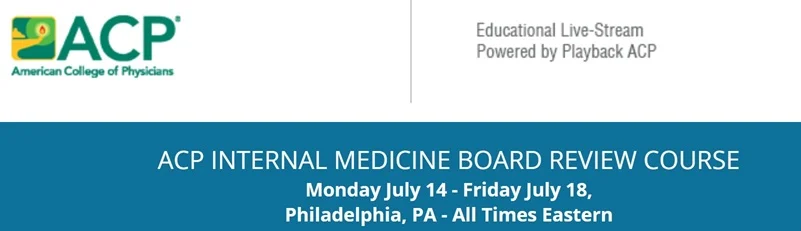
ACP Internal Medicine Board Review Course – July 2025 (Videos + Audios + Slides)


$130.00
This Product is shared via google drive download link, So please share your correct Gmail id while placing the order .Please note that there are no CME points or certificate associated with this course Samples for Courses Can be found here : Free Samples Here!
Format: 41 MP4 + 5 MP3 + 30 PDF files
ACP Internal Medicine Board Review Course – July 2025
Advanced ABIM Internal Medicine Board Preparation & Clinical Review
Preparing for the ABIM Internal Medicine Certification exam requires far more than memorizing isolated disease facts or treatment algorithms. Modern internal medicine demands the ability to synthesize multisystem pathology, interpret complex clinical presentations, prioritize diagnostics under uncertainty, and apply evidence-based management across a broad spectrum of inpatient and outpatient conditions.
The ACP Internal Medicine Board Review Course – July 2025 was developed with that reality in mind. Organized by the American College of Physicians (ACP), this intensive board review program combines high-yield exam preparation with clinically grounded teaching that mirrors real-world internal medicine practice. Held in Philadelphia from July 14–18, 2025, the course provides a comprehensive review of core ABIM topics through expert-led lectures, case-based discussions, clinical pearls, and structured reinforcement tools.
Rather than functioning solely as a traditional exam cram course, the program emphasizes clinical reasoning, diagnostic prioritization, and practical decision-making across nearly every major internal medicine discipline.
Course Format & Included Content
The course includes:
- Video lectures (.mp4)
- Audio recordings (.mp3)
- Downloadable slides and syllabi
- Clinical pearls PDFs
- Daily Q&A review files
- Daily Differential podcast summaries
- Multi-day specialty-focused review sessions
Coverage spans:
- Cardiology
- Pulmonary medicine
- Endocrinology
- Infectious diseases
- Gastroenterology
- Nephrology
- Hematology
- Oncology
- Neurology
- Rheumatology
- Dermatology
- Geriatrics
- Behavioral health
- Ethics and patient safety
- Women’s health and urologic medicine
The structure closely follows the ABIM exam blueprint while maintaining strong practical relevance for hospitalists, internists, and primary care physicians.
Why Internal Medicine Board Review Has Become More Complex
Internal medicine board preparation has evolved considerably over the past decade.
Clinicians are now expected to integrate:
- Preventive medicine
- Evidence-based screening
- Multimorbidity management
- Inpatient critical care
- Outpatient continuity care
- Guideline interpretation
- Diagnostic uncertainty
- Cross-specialty coordination
into rapid and accurate clinical decision-making.
At the same time, ABIM examinations increasingly emphasize:
- Case interpretation
- Clinical reasoning
- Next-best-step management
- Evidence application
- Risk stratification
rather than isolated memorization alone.
The ACP course reflects this shift by consistently using patient-centered, case-based educational frameworks rather than purely didactic topic review.
Cardiology & Pulmonary Medicine
The cardiovascular and pulmonary sections remain among the highest-yield areas for both board preparation and everyday clinical practice.
Cardiology modules review:
- Ischemic heart disease
- Heart failure
- Arrhythmias
- Valvular disease
- Hypertension
- Preventive cardiology
- ECG interpretation
- Anticoagulation strategies
Pulmonary sessions examine:
- COPD
- Asthma
- Pulmonary embolism
- Interstitial lung disease
- Respiratory failure
- Pulmonary infections
- Ventilator principles
One of the strengths of these discussions is their emphasis on diagnostic sequencing and management prioritization.
Many internal medicine patients present with overlapping cardiopulmonary symptoms where differentiating:
- Heart failure
from - Pneumonia
from - COPD exacerbation
from - Pulmonary embolism
requires structured clinical reasoning rather than algorithmic memorization alone.
The lectures repeatedly emphasize practical bedside interpretation and board-style clinical problem solving.
Endocrinology & Metabolic Medicine
The endocrinology curriculum provides detailed review of:
- Diabetes management
- Thyroid disorders
- Adrenal disease
- Pituitary disorders
- Calcium abnormalities
- Osteoporosis
- Metabolic syndromes
Modern endocrinology increasingly intersects with:
- Cardiovascular risk
- Obesity medicine
- Renal disease
- Critical care
- Preventive medicine
The course appropriately integrates endocrine physiology with practical outpatient and inpatient management scenarios.
Several discussions focus not only on disease recognition, but also on treatment sequencing and medication selection within complex multimorbid patients.
Infectious Disease & Preventive Medicine
The infectious disease modules review:
- Sepsis
- Antimicrobial stewardship
- HIV medicine
- Opportunistic infections
- Fever workups
- Vaccination strategies
- Emerging infectious diseases
The program also includes focused sessions on:
- Cancer screening
- Preventive medicine
- Population health
- Evidence-based screening recommendations
One important strength of the course is its attention to balancing evidence-based guidelines with individualized patient care.
In practice, preventive medicine often involves navigating:
- Competing comorbidities
- Age-related risk
- Patient preferences
- Screening harms versus benefits
- Resource utilization
rather than simply applying screening checklists mechanically.
Nephrology & Critical Care Medicine
The nephrology and ICU-focused sections remain particularly valuable for hospital-based clinicians.
Topics include:
- AKI
- Electrolyte disorders
- Acid-base interpretation
- CKD management
- Dialysis principles
- Volume assessment
- Shock physiology
- ICU complications
The lectures consistently emphasize physiologic reasoning and interpretation rather than rote memorization of formulas.
One recurring educational theme involves recognizing how small laboratory abnormalities may signal evolving multisystem instability in critically ill patients.
The critical care discussions appropriately focus on:
- Prioritization under pressure
- Early recognition of deterioration
- Management sequencing
- ICU diagnostic reasoning
which are highly relevant both for boards and real inpatient medicine.
Gastroenterology, Hematology & Oncology
The GI modules review:
- Liver disease
- GI bleeding
- Pancreatic disorders
- Inflammatory bowel disease
- Malabsorption syndromes
- Endoscopic indications
Hematology sessions examine:
- Anemia evaluation
- Coagulation disorders
- Cytopenias
- Hematologic malignancies
- Transfusion medicine
Oncology lectures focus on:
- Cancer diagnosis
- Screening strategies
- Oncologic emergencies
- Treatment complications
- Risk stratification
The multidisciplinary overlap between these specialties is particularly well integrated throughout the course.
Many internal medicine patients present with nonspecific symptoms where:
- GI disease
- Hematologic abnormalities
- Malignancy
- Infection
- Autoimmune disease
must all be considered simultaneously within the differential diagnosis.
Neurology, Rheumatology & Behavioral Health
The neurology review covers:
- Stroke
- Seizures
- Headache disorders
- Neuromuscular disease
- Dementia
- Movement disorders
Rheumatology sessions include:
- Vasculitis
- Connective tissue disease
- Inflammatory arthritis
- Crystal arthropathies
- Immunologic disorders
Behavioral health discussions address:
- Depression
- Anxiety
- Substance use disorders
- Cognitive disorders
- Psychiatric manifestations of medical illness
Importantly, these modules emphasize symptom interpretation and diagnostic pattern recognition rather than isolated disease lists.
The discussions repeatedly reinforce that internal medicine physicians often serve as the first point of recognition for neurologic, psychiatric, and autoimmune disease.
Geriatrics, Ethics & Patient Safety
The geriatrics and ethics sections provide clinically practical review of:
- Polypharmacy
- Frailty
- Delirium
- Capacity assessment
- Goals-of-care discussions
- Patient safety principles
- Ethical dilemmas in medicine
These topics are increasingly emphasized both in ABIM examinations and modern internal medicine practice.
The course appropriately highlights the complexity of decision-making in medically fragile and aging patient populations.
Reinforcement Tools & Learning Strategy
One particularly strong feature of the ACP Board Review Course is its multimodal reinforcement structure.
Included educational tools consist of:
- Daily Differential podcasts
- Clinical Pearls PDFs
- Faculty Q&A transcripts
- Downloadable syllabi
- Case-based review sessions
This layered approach helps reinforce retention while accommodating different learning styles and review strategies.
Who Benefits Most From This Course
The course is especially valuable for:
- Internal medicine residents
- Hospitalists
- Practicing internists
- Primary care physicians
- Physicians preparing for ABIM certification
- Clinicians preparing for recertification or MOC
Because the curriculum combines board-focused review with clinically realistic teaching, it serves equally well as:
- Exam preparation
- Broad internal medicine update
- Structured CME review
- Teaching resource for residency education
Final Expert Perspective
The ACP Internal Medicine Board Review Course – July 2025 succeeds because it approaches internal medicine as a dynamic clinical discipline rather than a collection of isolated exam facts.
By integrating case-based reasoning, multisystem interpretation, guideline-driven management, and practical bedside decision-making across every major internal medicine specialty, the course mirrors the complexity of modern patient care while remaining tightly aligned with ABIM board preparation.
For physicians preparing for certification, strengthening diagnostic reasoning, or refreshing broad clinical knowledge across internal medicine, this remains one of the most comprehensive and clinically relevant board review programs currently available.
Related products
Endocrine and Nutrition
Cardiology
Endocrine and Nutrition

Endocrine and Nutrition
Endocrine and Nutrition

Endocrine and Nutrition
Harvard Testosterone Therapy and Sexual Dysfunction February 2023
Nephrology / Urology