
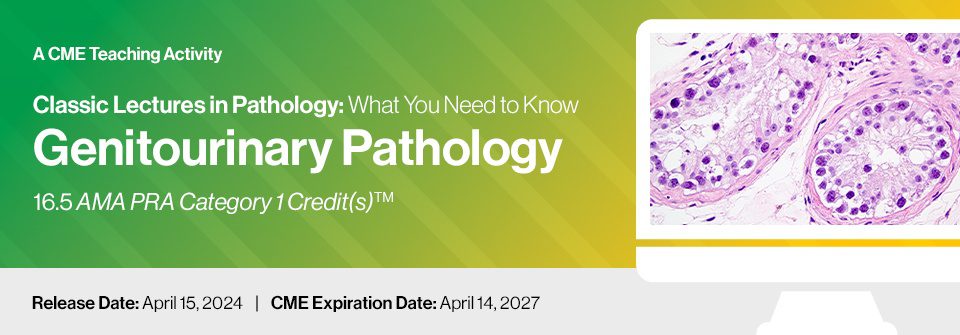






2024 Classic Lectures in Pathology: What You Need to Know – Genitourinary
Advanced Genitourinary Pathology CME Video Course
The 2024 Classic Lectures in Pathology: What You Need to Know – Genitourinary is a comprehensive CME video teaching activity designed to provide practicing pathologists with an advanced, practical, and highly focused review of modern genitourinary pathology. This expert-led educational program combines foundational diagnostic principles with advanced updates in prostate, bladder, kidney, and testicular pathology while emphasizing real-world diagnostic pitfalls, morphologic interpretation, tumor classification, grading systems, and case-based pathology review.
This practical pathology course focuses on:
- Prostate pathology
- Renal tumor classification
- Bladder tumor pathology
- Urothelial carcinoma
- Kidney carcinoma updates
- Testicular tumor pathology
- Genitourinary biomarkers
- Prostate cancer grading
- Intraductal prostate lesions
- Diagnostic pitfalls in GU pathology
- Pattern-based renal tumor diagnosis
- Eosinophilic renal neoplasms
- Flat and papillary bladder lesions
The curriculum emphasizes:
- Daily surgical pathology sign-out challenges
- Differential diagnosis strategies
- Morphologic pattern recognition
- WHO classification updates
- Ancillary testing and biomarkers
- Diagnostic accuracy improvement
- Pitfall avoidance in GU pathology
Through expert lectures and practical case discussions, the course provides a modern and clinically relevant update for pathologists involved in genitourinary surgical pathology.
Why Genitourinary Pathology Has Become Increasingly Complex
Modern genitourinary pathology continues evolving rapidly due to:
- Expanded WHO tumor classifications
- Molecular pathology integration
- Emerging renal tumor entities
- New prostate cancer grading systems
- Biomarker-driven oncology
- Variant histologies
- Precision medicine applications
Pathologists today must integrate:
- Histomorphology
- Immunohistochemistry
- Molecular findings
- Clinical correlation
- Biomarker interpretation
- Risk stratification systems
into increasingly sophisticated diagnostic workflows.
At the same time, GU pathology frequently involves:
- Overlapping morphologic patterns
- Rare tumor variants
- Small biopsy interpretation challenges
- Ambiguous lesions
- Evolving terminology
This CME activity was specifically designed to address these complexities through a highly practical and clinically focused educational approach.
Educational Focus
Practical Genitourinary Surgical Pathology
One of the strongest features of this course is its:
Practical sign-out oriented teaching style
Rather than functioning purely as a theoretical pathology review, the course repeatedly emphasizes:
- Real diagnostic challenges
- Daily pathology workflow
- Common interpretive traps
- Differential diagnosis strategies
- Morphologic clues
- Practical reporting guidance
- Clinical relevance of pathology findings
The lectures help pathologists improve:
- Diagnostic confidence
- Morphologic interpretation
- Classification accuracy
- Tumor grading consistency
- Recognition of difficult mimics
This makes the program especially valuable for:
- General surgical pathologists
- GU pathology specialists
- Academic pathologists
- Community practice pathologists
- Fellows and pathology residents
Prostate Pathology
A major focus of the course involves:
Modern prostate pathology updates
The curriculum reviews:
- Prostate needle biopsy interpretation
- Prostate cancer grading
- Intraductal carcinoma
- Mimickers of prostate cancer
- False positive diagnoses
- False negative diagnoses
- Atypical prostate lesions
- Diagnostic uncertainty in prostate pathology
The lecture:
What’s New in Prostate Pathology?
explores:
- Contemporary grading updates
- Emerging morphologic patterns
- WHO classification changes
- Clinical implications of grading systems
Special emphasis is placed on:
- Avoiding overdiagnosis
- Identifying subtle carcinoma
- Distinguishing benign mimics
- Accurate Gleason grading
The sessions:
False Positive, False Negative and Atypical Diagnoses in Prostate Pathology
and
Mimickers of Prostate Cancer
are particularly valuable because prostate pathology remains one of the most challenging areas for diagnostic interpretation in surgical pathology practice.
Intraductal Lesions & Prostate Cancer Grading
The lecture:
Intraductal Lesions of the Prostate
provides practical review of:
- Intraductal carcinoma
- High-grade PIN
- Cribriform architecture
- Differential diagnosis
- Reporting considerations
- Clinical significance
Modern prostate cancer grading continues evolving, making the:
Update on Prostate Cancer Grading
especially important for pathologists seeking current consensus recommendations and standardized grading strategies.
Renal Tumor Classification
One of the strongest sections of the course involves:
Renal tumor pathology
The lectures review:
- Pattern-based renal tumor diagnosis
- Eosinophilic renal neoplasms
- Emerging renal carcinoma entities
- Morphologic classification strategies
- Differential diagnosis algorithms
- Molecular correlations
The:
A Pattern-Based Approach to Renal Tumor Classification
lecture helps pathologists systematically approach:
- Clear cell tumors
- Papillary lesions
- Eosinophilic neoplasms
- Oncocytic tumors
- Hybrid morphologies
while improving diagnostic efficiency and consistency.
The sessions:
Pink Renal Tumors: How Far Can You Go With Morphology?
and
The Differential Diagnosis of Eosinophilic Renal Epithelial Neoplasms
are especially useful because eosinophilic renal tumors remain one of the most diagnostically difficult categories in GU pathology.
Kidney Carcinoma Updates
The lecture:
New Developments in Kidney Carcinoma: What’s Important and Why
reviews:
- Newly recognized renal tumors
- Molecularly defined neoplasms
- WHO classification updates
- Emerging diagnostic criteria
- Prognostic implications
Modern renal tumor pathology increasingly depends on integration between:
- Morphology
- Immunohistochemistry
- Molecular testing
- Clinical behavior
The course provides practical guidance on how to apply these updates in routine pathology practice.
Bladder Pathology & Urothelial Carcinoma
The bladder pathology curriculum explores:
- Flat urothelial lesions
- Papillary urothelial lesions
- Urothelial carcinoma variants
- Tumor grading systems
- Bladder cancer staging
- Reporting recommendations
- Diagnostic pitfalls
The lecture:
Diagnosis, Staging, and Grading of Urothelial Carcinoma
provides highly practical review of:
- Invasion assessment
- Histologic grading
- Variant histology recognition
- Staging challenges
- Reporting standards
Meanwhile:
Urothelial Carcinoma: Common Diagnostic Challenges and Variants Not to Be Missed in Practice
focuses on:
- Rare variants
- Pitfall lesions
- Mimickers
- Diagnostic traps
- High-yield morphologic clues
The course appropriately emphasizes how variant histologies increasingly affect:
- Prognosis
- Treatment planning
- Molecular testing
- Clinical management
Testicular Pathology
The course also includes:
Testicular tumor pathology updates
Topics include:
- Germ cell tumors
- Testicular precursor lesions
- Differential diagnosis
- Tumor classification
- Diagnostic pitfalls
- Challenging testicular lesions
The sessions:
Testicular Tumors: Updates and Most Common Diagnostic Challenges
and
Pitfalls in the Assessment of Testicular Pathology
help pathologists navigate one of the more uncommon yet highly specialized areas of GU pathology.
Biomarkers & Ancillary Testing
The lecture:
Biopsies and Biomarkers in Genitourinary Pathology
reviews:
- Modern GU biomarkers
- Ancillary testing applications
- Immunohistochemistry
- Molecular diagnostics
- Biomarker interpretation
- Clinical relevance of biomarker testing
Modern GU pathology increasingly requires integration of:
- Morphology
- Immunoprofiles
- Molecular findings
- Targeted therapy biomarkers
into routine diagnostic workflows.
Faculty & Expert Instructors
Michelle S. Hirsch, MD, PhD
- Biopsies and Biomarkers in Genitourinary Pathology
- Differential Diagnosis of Eosinophilic Renal Neoplasms
Sean R. Williamson, MD
- Renal Tumor Classification
- Prostate Pathology Updates
- Testicular Tumors
Kiril Trpkov, MD, FRCPC
- Kidney Carcinoma Developments
- Urothelial Carcinoma Variants
- Prostate Pathology Pitfalls
Jonathan I. Epstein, MD
- Urothelial Carcinoma
- Intraductal Prostate Lesions
- Prostate Cancer Grading
- Kidney Pathology
- Mimickers of Prostate Cancer
- Testicular Pathology Pitfalls
Cristina Magi-Galluzzi, MD, PhD
- Pink Renal Tumors
- Bladder Cancer Classification
- Prostate Cancer
Who This Course Is For
This course is ideal for:
- Surgical pathologists
- GU pathology specialists
- Community pathologists
- Academic pathologists
- Pathology fellows
- Pathology residents
It is especially valuable for professionals seeking:
- Modern GU pathology updates
- Prostate pathology review
- Renal tumor classification training
- Bladder pathology education
- GU pathology CME
- Diagnostic pitfall review
- Advanced surgical pathology education
Final Expert Perspective
The 2024 Classic Lectures in Pathology: What You Need to Know – Genitourinary stands out as a highly practical and clinically focused update in modern genitourinary pathology.
By combining:
- Prostate pathology
- Renal tumor classification
- Bladder cancer pathology
- Urothelial carcinoma variants
- Testicular pathology
- Biomarker integration
- Diagnostic pitfalls
- Case-based interpretation
the course delivers a valuable educational experience for pathologists navigating increasingly complex GU pathology practice.
For surgical pathologists, GU specialists, fellows, and trainees, this CME activity provides an excellent opportunity to strengthen diagnostic accuracy, improve classification consistency, and remain current with evolving standards in genitourinary pathology.