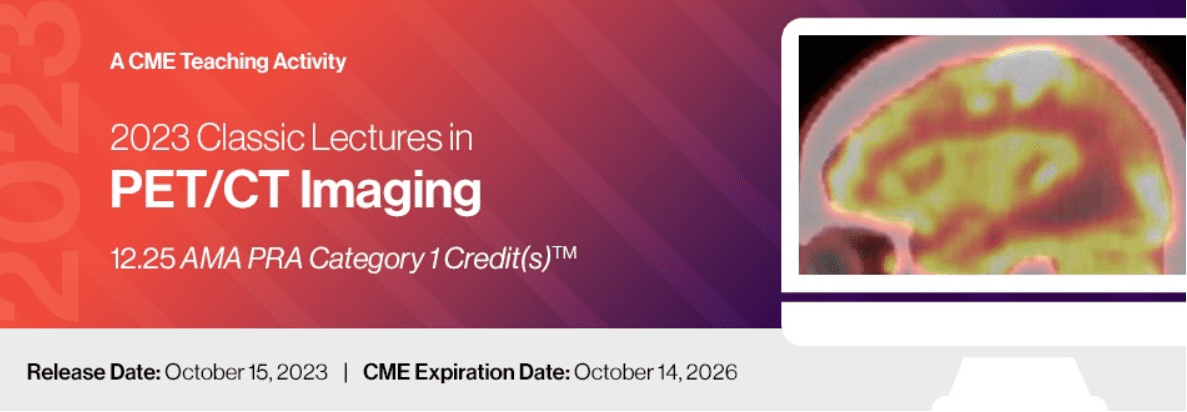

2023 Classic Lectures in PET/CT Imaging – A CME Teaching Activity
Master modern molecular imaging with this comprehensive CME course covering the latest clinical applications of PET and PET/CT imaging across oncology, cardiology, neurology, infection imaging, and theranostics.
This educational activity combines some of the most highly rated classic lectures in PET/CT imaging, featuring practical case-based teaching from leading experts in radiology and nuclear medicine. From foundational imaging principles to advanced oncologic and radionuclide applications, the course delivers clinically focused instruction designed to improve diagnostic accuracy and optimize patient management.
Course Overview
The 2023 Classic Lectures in PET/CT Imaging provides a broad review of:
- PET imaging fundamentals
- PET/CT interpretation
- Reporting principles
- Oncologic imaging applications
- Neurodegenerative disease imaging
- Cardiac PET
- Infection and inflammation imaging
- Theranostics
- Quantitative response assessment
The course emphasizes:
- Practical interpretation strategies
- Disease-specific imaging patterns
- Reporting pearls
- Common pitfalls
- Treatment response evaluation
- Case-based learning
Faculty members integrate:
- Clinical context
- Imaging protocols
- Quantitative assessment
- Advanced radionuclide techniques
- Modern PET tracers
into real-world clinical applications.
Educational Focus
This CME activity is specifically designed to help physicians:
- Improve PET/CT interpretation skills
- Understand current imaging standards
- Optimize oncologic staging
- Apply quantitative PET response criteria
- Recognize imaging pitfalls
- Integrate PET imaging into multidisciplinary patient care
The course bridges:
- Basic PET imaging concepts
- Advanced molecular imaging applications
- Clinical oncology decision-making
- Hybrid imaging interpretation
making it highly valuable for both practicing clinicians and trainees.
Course Details
📅 Release Date: October 15, 2023
🎓 Format: CME Video Teaching Activity
🩻 Specialties: Radiology, Nuclear Medicine, Oncology, Radiation Oncology
Who This Course Is For
This course is ideal for:
- Radiologists
- Nuclear medicine physicians
- Oncologists
- Radiation oncologists
- PET/CT imaging specialists
- Fellows and residents
- Physicians ordering PET imaging studies
It is particularly valuable for clinicians seeking practical updates in:
- Molecular imaging
- Oncologic PET
- Hybrid imaging interpretation
- Theranostics
- Quantitative PET assessment
Key Learning Areas
PET/CT Techniques and Reporting Principles
The course begins with foundational instruction on:
- PET acquisition techniques
- Standardized reporting
- SUV interpretation
- Protocol optimization
- Hybrid PET/CT workflow
This section helps clinicians develop a systematic approach to:
- Image interpretation
- Structured reporting
- Quantitative assessment
- Clinical correlation
while avoiding common technical and interpretive pitfalls.
Oncology PET/CT Applications
A major focus of the course is:
Comprehensive oncologic PET/CT imaging
Disease-specific lectures review PET/CT applications in:
- Lung cancer
- Head and neck cancer
- Thyroid cancer
- Breast malignancies
- Female pelvic cancers
- Lymphoma
- Prostate cancer
- Skeletal tumors
- Skin cancers
- Neuroendocrine tumors
These sessions emphasize:
- Tumor staging
- Treatment planning
- Response assessment
- Recurrence detection
- Prognostic imaging findings
PET/CT in Lung Cancer
The lung cancer section reviews:
- Initial staging
- Nodal assessment
- Metastatic evaluation
- Radiation treatment planning
- Post-treatment surveillance
Faculty discuss:
- FDG uptake patterns
- False positives
- Inflammatory mimics
- Small lesion limitations
- Quantitative interpretation strategies
Head and Neck PET/CT
The course explores:
PET/CT in head and neck malignancies
with emphasis on:
- Primary tumor localization
- Cervical nodal staging
- Post-treatment surveillance
- Recurrence detection
- Radiation therapy planning
Special attention is given to:
- Physiologic uptake pitfalls
- Post-treatment inflammatory changes
- Complex head and neck anatomy
PET/CT in Prostate Cancer
Modern prostate imaging applications include:
- PSMA imaging principles
- Recurrence localization
- Metastatic assessment
- Biochemical recurrence
- Treatment planning
This section highlights the rapidly evolving role of molecular imaging in:
- Precision oncology
- Targeted therapies
- Personalized prostate cancer management
Neurodegenerative Disease Imaging
The course includes dedicated instruction on:
PET imaging in neurodegenerative disorders
Topics include:
- Dementia imaging
- Alzheimer disease patterns
- FDG brain PET interpretation
- Differential diagnosis
- Functional brain imaging
Faculty demonstrate how PET can improve:
- Diagnostic confidence
- Disease characterization
- Clinical management
in neurologic practice.
Cardiac PET Imaging
Advanced cardiac applications include:
- Coronary disease imaging
- Cardiac sarcoidosis
- Myocardial viability
- Perfusion imaging
- Inflammatory cardiac disease
These lectures review:
- Cardiac PET protocols
- Functional assessment
- Inflammatory imaging
- Hybrid cardiac imaging techniques
Infection & Inflammation Imaging
One of the most clinically useful sections addresses:
PET/CT in infection and inflammation
Topics include:
- Fever of unknown origin
- Vasculitis
- Osteomyelitis
- Inflammatory disorders
- Infection localization
Faculty discuss:
- Appropriate indications
- Common imaging patterns
- Limitations of FDG imaging
- False-positive interpretation challenges
Theranostics & Advanced Molecular Imaging
A particularly important component of the course is:
PET/CT in Theragnostics
This rapidly growing field combines:
- Molecular imaging
- Targeted radionuclide therapy
- Personalized medicine
The course reviews:
- Theranostic principles
- Patient selection
- DOTATATE imaging
- Neuroendocrine tumor imaging
- Lu-177 therapies
These lectures provide important insight into the future of:
- Precision oncology
- Targeted radionuclide treatment
- Molecular-guided therapy
Quantitative PET Assessment
The lecture:
Qualitative and Quantitative Response Criteria
covers:
- SUV measurements
- Response assessment systems
- RECIST and PET criteria
- Treatment monitoring
- Standardized interpretation
This is particularly valuable for oncologists and imaging specialists involved in:
- Clinical trials
- Longitudinal patient monitoring
- Therapy response assessment
Radionuclide Imaging Foundations
The course also includes classic lectures on:
- Whole body PET imaging
- Endocrine radionuclide imaging
- CNS radionuclide imaging
- Cardiovascular radionuclide imaging
These sessions provide a strong foundation in:
- Nuclear medicine principles
- Radiotracer applications
- Physiologic imaging interpretation
Featured Faculty
The course is taught by internationally recognized experts including:
- Erik S. Mittra, MD, PhD
- Gagandeep Choudhary, MD
- Mark I. Travin, MD
- Don C. Yoo, MD
- Mark Tulchinsky, MD, FACNM
- Katherine Zukotynski, MD
- Edwin L. Palmer, MD
- Carl K. Hoh, MD
Their lectures emphasize:
- Practical interpretation
- Case-based learning
- Imaging pearls
- Real-world applications
Key Topics Included
- PET/CT reporting principles
- Neurodegenerative PET imaging
- Cardiac PET
- Head and neck cancer PET
- Thyroid cancer PET
- Lung cancer imaging
- Breast and pelvic malignancies
- Quantitative response criteria
- Infection and inflammation imaging
- Theranostics
- Neuroendocrine tumor imaging
- Lymphoma PET
- Prostate cancer PET
- Skeletal tumor imaging
- Skin cancer imaging
- Whole body PET
- CNS radionuclide imaging
Why This Course Matters
PET/CT imaging continues to transform:
- Cancer staging
- Precision oncology
- Treatment monitoring
- Molecular diagnostics
- Personalized medicine
This course helps clinicians:
✔️ Improve diagnostic confidence
✔️ Interpret PET/CT systematically
✔️ Recognize common pitfalls
✔️ Apply quantitative imaging correctly
✔️ Integrate molecular imaging into patient management
✔️ Stay updated on theranostics and advanced PET applications
Final Perspective
The 2023 Classic Lectures in PET/CT Imaging is an outstanding educational resource for clinicians seeking a practical yet comprehensive review of modern PET imaging.
By combining:
- Foundational imaging principles
- Advanced oncologic applications
- Quantitative assessment
- Neuroimaging
- Cardiac PET
- Theranostics
- Infection imaging
with case-based instruction from internationally recognized faculty, this course delivers highly relevant and clinically applicable molecular imaging education.
It is particularly valuable for radiologists, nuclear medicine physicians, oncologists, and trainees aiming to strengthen their expertise in PET/CT interpretation and modern hybrid imaging practice.