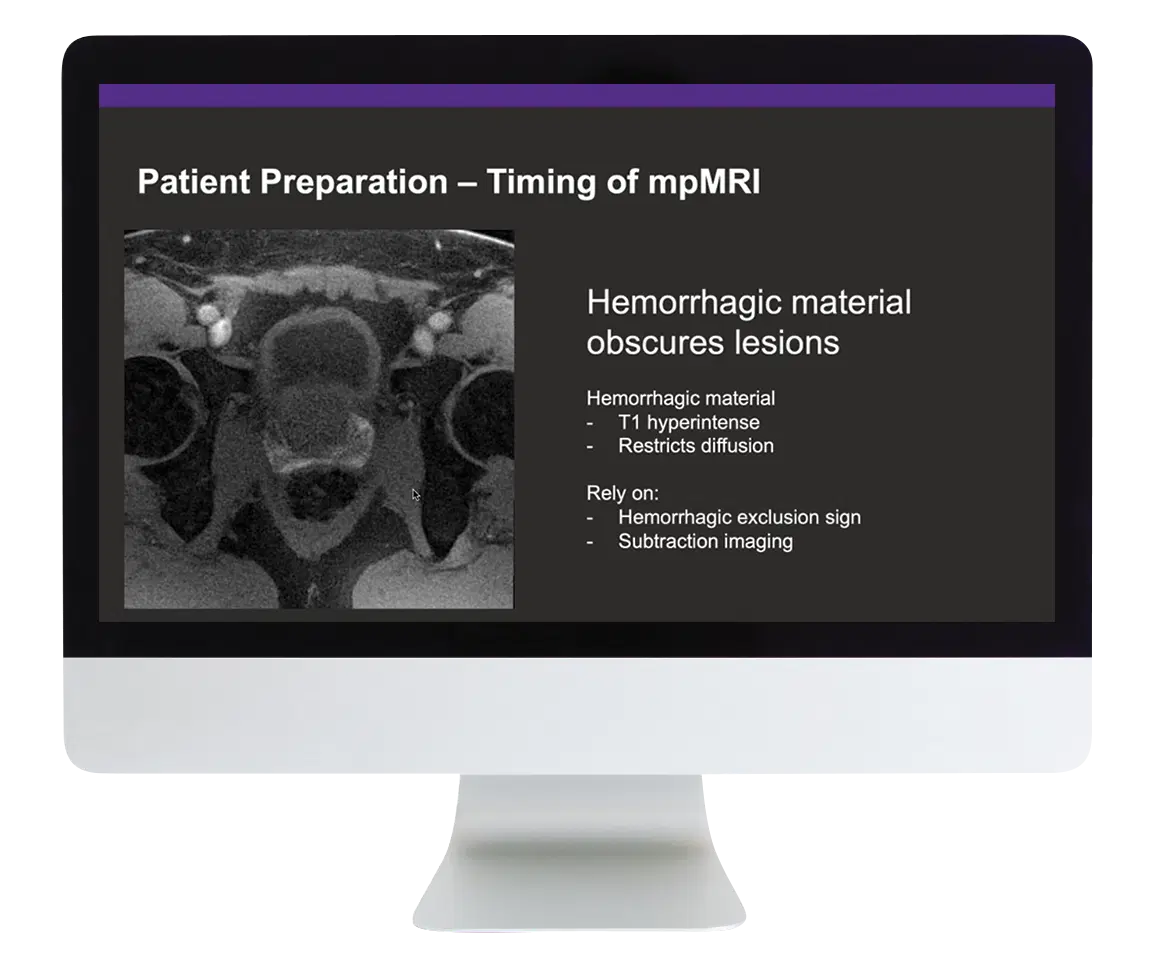
Prostate MR Case Review 2024


$60.00
This Product is shared via google drive download link, So please share your correct Gmail id while placing the order .Please note that there are no CME points or certificate associated with this course Samples for Courses Can be found here : Free Samples Here




Prostate MR Case Review 2024
Advanced Multi-Parametric Prostate MRI Interpretation Course
The Prostate MR Case Review 2024 is a comprehensive radiology education program designed to provide advanced training in modern multi-parametric prostate MRI (mpMRI), prostate cancer detection, PI-RADS interpretation, local staging, post-treatment imaging, focal therapy assessment, and PSMA PET integration.
As prostate cancer diagnosis continues to rise among men worldwide, multi-parametric prostate MRI has become one of the most important imaging tools in modern genitourinary radiology and urologic oncology. This course delivers a highly practical, case-based review of prostate MRI interpretation, helping radiologists improve diagnostic confidence, reporting consistency, and accuracy in daily prostate imaging practice.
The course focuses on:
- High-quality prostate MRI acquisition
- PI-RADS v2.1 interpretation
- Diffusion-weighted imaging (DWI)
- Dynamic contrast-enhanced imaging (DCE)
- Prostate cancer detection and localization
- Local staging and extracapsular extension (EPE)
- Post-treatment prostate MRI
- PI-RR interpretation
- Focal therapy imaging
- PSMA PET integration
- Diagnostic pearls and pitfalls
Through expert-led lectures and real-world case reviews, participants gain practical guidance on performing and interpreting prostate MRI according to modern international standards.
Why Prostate MRI Has Become Essential in Modern Urologic Imaging
Prostate cancer remains one of the most common cancers affecting men worldwide.
Over the past decade, multi-parametric prostate MRI has dramatically transformed:
- Prostate cancer diagnosis
- Risk stratification
- Active surveillance
- Biopsy targeting
- Local staging
- Treatment planning
- Recurrence evaluation
Modern mpMRI combines:
- T2-weighted imaging
- Diffusion-weighted imaging (DWI)
- ADC mapping
- Dynamic contrast enhancement (DCE)
to improve detection of clinically significant prostate cancer while reducing unnecessary biopsies and overtreatment.
At the same time, radiologists increasingly face challenges involving:
- PI-RADS standardization
- Benign mimics of cancer
- Post-biopsy changes
- Post-treatment fibrosis
- Small lesion interpretation
- Focal therapy assessment
- Extraprostatic extension evaluation
This course was specifically designed to address these challenges using a highly practical, case-based educational format.
Educational Focus
Practical Case-Based Prostate MRI Interpretation
One of the strongest features of this course is its:
Real-world case review approach
The lectures emphasize:
- Daily prostate MRI workflow
- PI-RADS interpretation strategies
- Common diagnostic pitfalls
- Technical optimization
- Local staging accuracy
- Clinical decision-making support
Rather than relying solely on theory, the course uses:
- Practical imaging examples
- Challenging case discussions
- Pattern recognition strategies
- Pitfall analysis
- Step-by-step interpretation guidance
This makes the program highly valuable for both:
- General radiologists
and - Dedicated GU imaging specialists
Multi-Parametric Prostate MRI Fundamentals
The course begins with foundational principles of:
High-quality prostate MRI acquisition
Participants learn how to:
- Optimize imaging technique
- Maintain image quality
- Improve lesion detection
- Minimize artifacts
- Standardize prostate MRI protocols
Modern prostate MRI quality directly impacts:
- Diagnostic accuracy
- PI-RADS scoring reliability
- Cancer localization
- Treatment planning
The course reviews technical considerations involving:
- T2-weighted imaging
- Diffusion-weighted imaging
- ADC maps
- Dynamic contrast enhancement
- MRI protocol optimization
PI-RADS v2.1 Interpretation
A major educational focus involves:
PI-RADS v2.1 case-based interpretation
PI-RADS has become the global standard for:
- Prostate MRI reporting
- Risk stratification
- Lesion classification
- Communication with urologists
The course reviews:
- Transition zone lesions
- Peripheral zone lesions
- Diffusion-weighted imaging interpretation
- DCE interpretation
- PI-RADS scoring algorithms
- Lesion categorization strategies
Participants learn how to:
- Identify clinically significant prostate cancer
- Improve consistency in reporting
- Reduce interobserver variability
- Avoid common scoring errors
Pearls & Pitfalls in Prostate MRI
One of the most valuable sections focuses on:
Diagnostic pitfalls and mimics of prostate cancer
Radiologists frequently encounter benign conditions that can simulate malignancy, including:
- Prostatitis
- Post-biopsy hemorrhage
- BPH nodules
- Fibrosis
- Atrophy
- Treatment-related changes
The course teaches:
- Key differentiating imaging features
- Common interpretation mistakes
- Strategies to improve specificity
- How to avoid overcalling benign findings
This section is especially useful because accurate prostate MRI interpretation depends heavily on recognizing subtle imaging patterns and avoiding false positives.
Local Staging & Extraprostatic Extension (EPE)
The lecture:
Local Staging: EPE or No EPE?
provides detailed review of:
- Extraprostatic extension
- Seminal vesicle invasion
- Neurovascular bundle involvement
- Capsular irregularity
- Local tumor spread
Local staging is critically important because it directly affects:
- Surgical planning
- Radiation therapy decisions
- Prognosis
- Treatment selection
The course emphasizes:
- MRI features of EPE
- Staging accuracy
- Diagnostic confidence
- Imaging limitations
Post-Treatment MRI & PI-RR
Modern prostate imaging increasingly involves:
Post-treatment assessment
The course reviews:
- PI-RR interpretation
- MRI after focal therapy
- Recurrence evaluation
- Post-treatment fibrosis
- Residual disease detection
As focal therapies and minimally invasive prostate cancer treatments continue expanding, radiologists must become familiar with:
- Expected post-treatment appearances
- Residual tumor patterns
- Recurrence imaging criteria
- PI-RR reporting systems
This section provides highly practical guidance for post-treatment prostate MRI interpretation.
Focal Therapy Imaging
The:
Focal Therapy: What You Need to Know
lecture explores:
- Focal ablation techniques
- MRI-guided therapy
- Post-treatment imaging changes
- Patient selection considerations
- Imaging follow-up protocols
Focal therapy represents one of the fastest-growing areas in prostate cancer management, making this topic particularly relevant for modern GU radiologists.
PSMA PET & Hybrid Imaging
The course also reviews:
PSMA PET imaging
including:
- Current clinical applications
- Emerging indications
- Integration with MRI
- Staging and recurrence assessment
- Future directions in prostate imaging
PSMA PET has rapidly transformed:
- Prostate cancer staging
- Biochemical recurrence evaluation
- Metastatic disease detection
The course helps radiologists understand how PSMA PET complements prostate MRI in modern oncologic imaging workflows.
Faculty & Lectures
Angela Tong, MS, MD
- Optimizing Technique and Maintaining Quality
Rajan Gupta, MD
- PI-RADS v2.1 Case-Based Interpretation
Silvia Chang, MD
- Pearls and Pitfalls
Antonio Westphalen, MD, PhD
- Local Staging: EPE or No EPE?
Kate Hanneman, MD, MPH
- PI-RR with Case-Based Interpretation
Elsie T. Nguyen, MD, FRCPC
- Focal Therapy: What You Need to Know
Devaki Shilpa Surasi, MD
- PSMA PET: Where Are We and Where Are We Going?
Sandeep Arora, MBBS
- Case Review
Learning Outcomes
After completing this course, participants should be able to:
- Perform high-quality multi-parametric prostate MRI
- Interpret prostate MRI using PI-RADS v2.1
- Recognize prostate cancer mimics and imaging pitfalls
- Evaluate post-treatment MRI using PI-RR
- Understand local staging and extracapsular extension
- Integrate PSMA PET into prostate imaging workflows
- Improve prostate MRI reporting consistency and accuracy
Who This Course Is For
This course is ideal for:
- Radiologists
- Genitourinary imaging specialists
- Abdominal imaging radiologists
- Radiology fellows
- Urologists interested in prostate MRI
- Oncologic imaging specialists
It is especially valuable for professionals seeking:
- PI-RADS training
- Prostate MRI interpretation review
- GU radiology education
- Prostate cancer imaging updates
- PSMA PET integration guidance
- Case-based prostate MRI learning
Final Expert Perspective
The Prostate MR Case Review 2024 stands out because it combines technical MRI optimization, standardized PI-RADS interpretation, local staging assessment, post-treatment imaging, focal therapy evaluation, and PSMA PET integration into one highly practical educational program.
By emphasizing:
- Real-world case interpretation
- Diagnostic pearls and pitfalls
- Standardized reporting
- Modern prostate cancer imaging strategies
this course provides an exceptionally valuable update for radiologists involved in contemporary prostate MRI practice.
For GU radiologists, abdominal imagers, fellows, and clinicians working with prostate cancer imaging, this course offers a highly practical and clinically relevant review capable of improving diagnostic accuracy, reporting confidence, and overall prostate MRI performance.
Related products

Cardiology

Anesthesiology & pain medicine
Professional, Business, and OR Management Issues 2021 Module 7

Anesthesiology & pain medicine

Hematology / Oncology

Neurology / neurosurgery courses

Anesthesiology & pain medicine