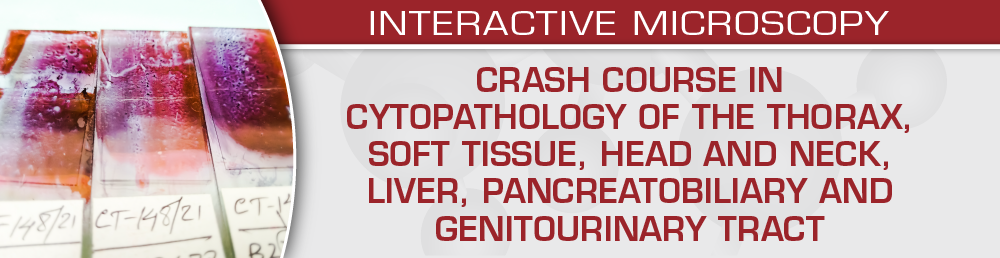



USCAP Crash Course in Cytopathology 2024
Thorax, Soft Tissue, Head & Neck, Liver, Pancreatobiliary and Genitourinary Tract
Advanced Cytopathology Diagnostic Review (Videos + PDFs)
The USCAP Crash Course in Cytopathology 2024 is an advanced, case-based educational program designed to provide pathologists with a highly practical and up-to-date review of modern cytopathology across multiple organ systems. Developed by the United States and Canadian Academy of Pathology (USCAP), this intensive course focuses on standardized cytologic reporting systems, WHO classification updates, diagnostic pitfalls, ancillary testing, and real-world cytomorphologic interpretation in daily pathology practice.
This comprehensive cytopathology course addresses diagnostic challenges involving:
- Thoracic cytopathology
- Lung and mediastinal lesions
- Soft tissue cytopathology
- Thyroid cytology
- Head and neck pathology
- Salivary gland cytology
- Liver and bile duct lesions
- Pancreatobiliary cytopathology
- Urine and genitourinary cytology
- Kidney and adrenal cytopathology
- Serous fluid cytology
The program emphasizes:
- Standardized reporting terminology
- WHO classification updates
- Algorithmic differential diagnosis
- Cytomorphologic interpretation
- Proper specimen handling
- Ancillary testing integration
- Recognition of diagnostic mimics and pitfalls
📅 Original Release Date: May 3, 2024
🎓 CME Credit: 11.5 CME
⏳ Course Access Expires: April 8, 2027
Included:
- Video lectures
- PDF educational materials
- Case-based cytopathology discussions
- Practical diagnostic algorithms
Why Modern Cytopathology Has Become Increasingly Complex
Cytopathology has evolved dramatically in recent years due to:
- Expanded WHO classifications
- Molecular pathology integration
- New reporting systems
- Precision oncology
- Ancillary testing advances
- Increased minimally invasive sampling
- Personalized cancer treatment strategies
Modern cytopathologists must now integrate:
- Cytomorphology
- Immunocytochemistry
- Molecular diagnostics
- Clinical imaging
- Biomarker testing
- Specimen adequacy assessment
into increasingly sophisticated diagnostic workflows.
At the same time, standardized reporting systems have become critically important for ensuring:
- Consistent communication
- Accurate risk stratification
- Appropriate clinical management
- International diagnostic reproducibility
This USCAP Crash Course directly addresses these evolving complexities with a highly practical and clinically focused educational approach.
Educational Focus
Practical Cytopathology for Daily Sign-Out
One of the strongest aspects of this USCAP course is its emphasis on:
Real-world diagnostic pathology
Rather than functioning solely as an academic review, the course repeatedly focuses on:
- Daily diagnostic challenges
- Cytologic mimics
- Common pitfalls
- Specimen handling
- Ancillary study interpretation
- Algorithmic diagnosis
- Clinical-pathologic correlation
The lectures are specifically designed to improve:
- Diagnostic confidence
- Cytologic accuracy
- Differential diagnosis skills
- Reporting consistency
- Practical sign-out efficiency
This makes the program exceptionally valuable for both:
- Community practice pathologists
and - Academic cytopathologists
Lung & Mediastinum Cytopathology
Thoracic cytopathology remains one of the most challenging and clinically important areas in modern cytology practice.
The lecture:
Lung and Mediastinum Cytopathology
reviews:
- Pulmonary neoplasms
- Mediastinal lesions
- Cytologic grading
- Differential diagnosis strategies
- Cytomorphologic mimics
- Ancillary testing interpretation
Modern thoracic cytopathology increasingly depends on:
- Small biopsy interpretation
- Fine needle aspiration (FNA)
- Molecular testing adequacy
- Biomarker evaluation for targeted therapy
The course emphasizes how cytopathologists can maximize diagnostic yield while minimizing interpretive errors in limited samples.
Pancreatobiliary & Liver Cytopathology
The pancreatobiliary and hepatobiliary sessions provide practical review of:
- Pancreatic cystic lesions
- Solid pancreatic neoplasms
- Bile duct lesions
- Liver cytology
- Malignant mimics
- Differential diagnosis algorithms
Cytologic evaluation of pancreatobiliary lesions remains particularly difficult because:
- Samples are often limited
- Reactive atypia may mimic malignancy
- Clinical management depends heavily on accurate classification
The course explores:
- Key cytomorphologic signatures
- WHO terminology updates
- Ancillary study utilization
- Diagnostic pitfalls
These sessions are especially useful for pathologists involved in:
- EUS-guided FNA interpretation
- Pancreatic lesion workup
- Liver lesion cytology
Thyroid Cytopathology
The:
Thyroid Cytopathology
lecture reviews:
- Cytologic classification systems
- Bethesda terminology
- Thyroid neoplasm interpretation
- Follicular-patterned lesions
- Diagnostic mimics
- Ancillary molecular testing
Modern thyroid cytopathology increasingly incorporates:
- Molecular diagnostics
- Risk stratification systems
- Standardized reporting terminology
The course provides practical guidance for improving consistency and reducing indeterminate diagnoses.
Head & Neck and Salivary Gland Cytopathology
Head and neck cytology often presents substantial diagnostic difficulty due to:
- Diverse lesion types
- Overlapping morphologic patterns
- Rare neoplasms
- Complex differential diagnoses
The session:
Head and Neck, and Salivary Gland Cytopathology
reviews:
- Salivary gland tumors
- Reactive lesions
- Squamous lesions
- Head and neck neoplasms
- WHO classification updates
- Cytologic mimics
Special emphasis is placed on:
- Accurate classification
- Avoiding overdiagnosis
- Appropriate ancillary testing
Genitourinary, Kidney & Adrenal Cytopathology
The GU cytopathology section explores:
- Urine cytology
- Kidney lesions
- Adrenal cytology
- Genitourinary neoplasms
- Non-neoplastic urinary findings
- Cytologic differential diagnosis
Modern urinary cytology increasingly depends on:
- Standardized reporting systems
- Risk stratification
- Clinical integration
- Molecular correlation
The lectures help pathologists recognize:
- Subtle malignant findings
- Reactive changes
- Common diagnostic pitfalls
Serous Fluid Cytopathology
The course also includes practical review of:
Serous Fluid Cytopathology
covering:
- Pleural fluid cytology
- Peritoneal fluid evaluation
- Pericardial fluid interpretation
- Reactive mesothelial changes
- Malignant effusions
- Metastatic disease patterns
The sessions emphasize:
- Cytomorphologic distinction between benign and malignant processes
- Common interpretive pitfalls
- Ancillary testing limitations
Soft Tissue Cytopathology
Soft tissue FNAs often create diagnostic uncertainty because:
- Mesenchymal tumors may demonstrate overlapping morphology
- Samples are limited
- Rare entities are frequently encountered
The:
Soft Tissue Cytopathology
lecture reviews:
- Mesenchymal neoplasms
- Differential diagnosis strategies
- Cytologic clues
- Ancillary studies
- Diagnostic algorithms
This is especially valuable for pathologists evaluating:
- FNA specimens
- Metastatic soft tissue lesions
- Spindle cell neoplasms
Standardized Reporting Systems & WHO Updates
A central educational theme throughout the course involves:
Standardized cytologic classification
The program repeatedly reviews:
- WHO terminology updates
- Reporting system revisions
- Uniform diagnostic language
- Risk stratification approaches
These frameworks are increasingly essential for:
- Clinical communication
- Treatment planning
- International diagnostic consistency
- Multidisciplinary oncology management
Learning Objectives
After completing this educational activity, participants should be able to:
- Understand updated cytologic classification systems
- Apply WHO terminology and reporting guidelines
- Integrate ancillary testing appropriately
- Recognize cytologic mimics and diagnostic pitfalls
- Use algorithmic differential diagnosis approaches
- Improve diagnostic consistency in cytopathology practice
- Interpret neoplastic and non-neoplastic cytologic specimens accurately
Faculty & Lectures
Adebowale J. Adeniran, MD
- Urine, Kidney, and Adrenal Cytopathology
- Serous Fluid Cytopathology
Lester J. Layfield, MD
- Lung and Mediastinum Cytopathology
- Soft Tissue Cytopathology
Michelle D. Reid, MD, MSc
- Pancreas Cytopathology
- Bile Duct and Liver Cytopathology
William C. Faquin, MD, PhD
- Thyroid Cytopathology
- Head and Neck, and Salivary Gland Cytopathology
Who This Course Is For
This course is ideal for:
- Cytopathologists
- Surgical pathologists
- Academic pathologists
- Community pathologists
- Pathology fellows
- Pathology residents
It is especially valuable for clinicians seeking:
- Modern cytopathology updates
- WHO classification review
- Cytology diagnostic algorithms
- Cytopathology board preparation
- Practical sign-out guidance
- Ancillary testing integration strategies
Final Expert Perspective
The USCAP Crash Course in Cytopathology 2024 stands out because it successfully combines modern classification systems, practical cytomorphologic interpretation, ancillary diagnostic integration, and real-world pathology workflow into one highly focused educational program.
By covering thoracic, pancreatobiliary, thyroid, head and neck, soft tissue, serous fluid, liver, and genitourinary cytopathology through a case-based and algorithmic approach, the course provides an exceptionally valuable update for pathologists navigating increasingly complex cytologic diagnosis.
For practicing pathologists, cytopathology fellows, and trainees, this course offers a highly practical and clinically relevant review capable of significantly improving diagnostic accuracy, reporting consistency, and confidence in daily cytopathology practice.