
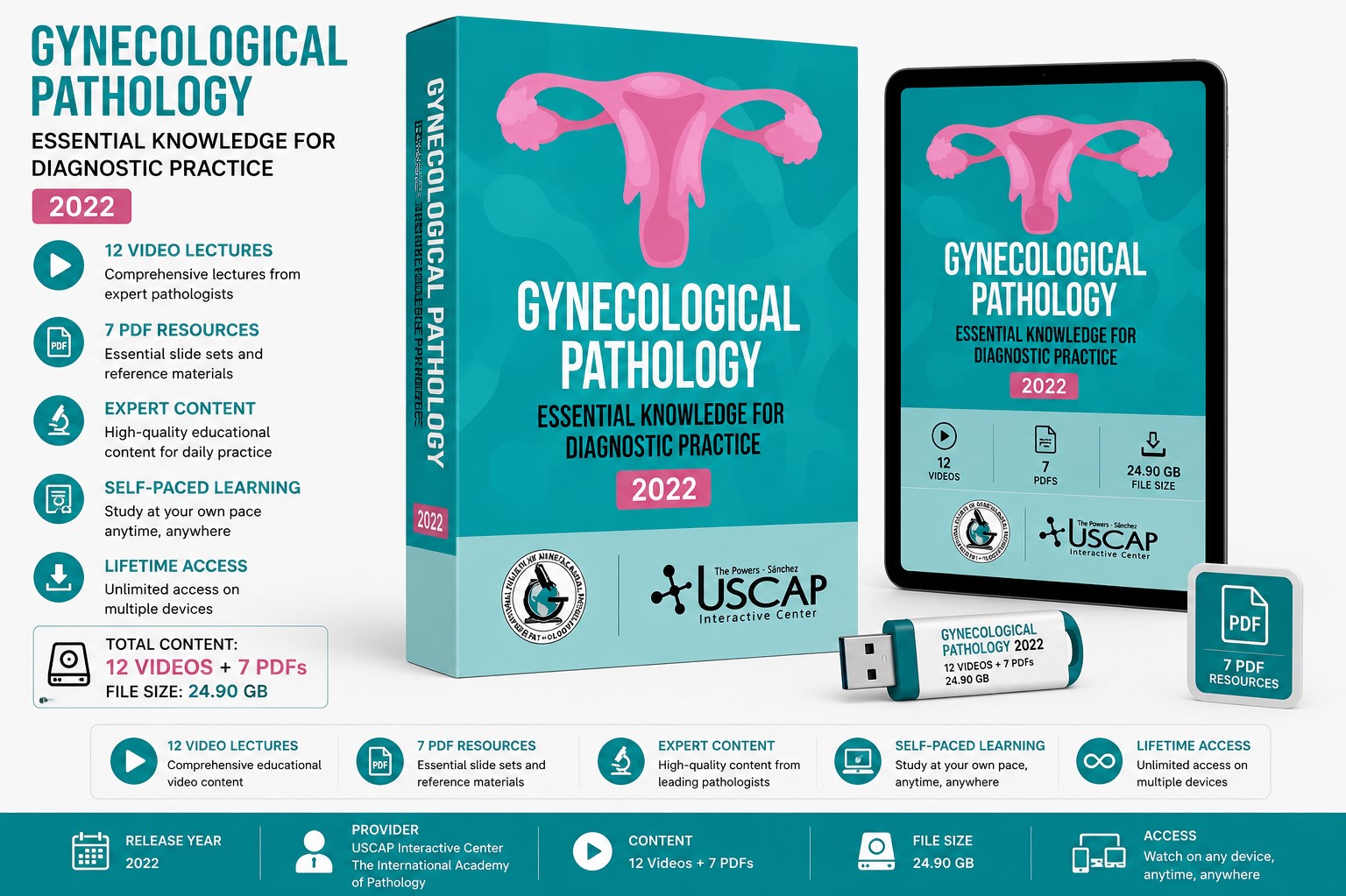
USCAP Gynecological Pathology: Essential Knowledge for Diagnostic Practice 2022

$55.00
12 Videos + 7 PDFs
File Size = 24.90 GB



USCAP Gynecological Pathology: Essential Knowledge for Diagnostic Practice 2022
Advanced Diagnostic Gynecologic Pathology with Morphology, Immunohistochemistry & Molecular Correlation
Gynecologic pathology remains one of the most diagnostically challenging areas within surgical pathology due to the large number of overlapping disease entities, evolving classification systems, and increasingly important molecular and immunohistochemical correlations. The USCAP Gynecological Pathology: Essential Knowledge for Diagnostic Practice 2022 course provides an intensive, case-focused review of modern gynecologic pathology with emphasis on difficult differential diagnoses, updated WHO classifications, and practical diagnostic application in routine pathology practice.
Developed in collaboration between the United States and Canadian Academy of Pathology (USCAP) and the International Society of Gynecological Pathologists (ISGyP), this four-day educational program combines expert faculty teaching with interactive microscope-based learning and advanced morphologic interpretation.
The course focuses heavily on integrating:
- Histomorphology
- Immunohistochemistry (IHC)
- Molecular pathology
- Clinical-pathologic correlation
- Updated diagnostic terminology
into accurate and clinically meaningful gynecologic pathology reporting.
Course Content
- 12 Video Lectures
- 7 PDF Files
- Total File Size: 24.90 GB
- Original Release Date: January 10, 2022
The Increasing Complexity of Modern Gynecologic Pathology
Over the past decade, gynecologic pathology has undergone major transformation due to:
- Molecular genetic discoveries
- Revised WHO classifications
- Expanded immunohistochemical panels
- Targeted therapy biomarkers
- New tumor subtyping systems
- Improved understanding of tumor biology
As a result, many gynecologic lesions that were previously grouped together are now recognized as biologically distinct entities with different:
- Prognoses
- Molecular profiles
- Therapeutic implications
- Clinical behaviors
The course repeatedly emphasizes that modern gynecologic pathology increasingly requires combining traditional morphology with molecular and immunophenotypic data rather than relying on histology alone.
Morphologic Recognition & Diagnostic Pattern Analysis
A major strength of the course is its emphasis on morphologic pattern recognition.
Topics include:
- Architectural growth patterns
- Cytologic atypia
- Stromal characteristics
- Tumor differentiation
- Invasion patterns
- Mimickers and pitfalls
In practice, many gynecologic pathology diagnoses remain morphology-driven initially, even in the era of molecular diagnostics.
The course appropriately highlights how subtle histologic features often determine:
- Correct tumor classification
- Appropriate ancillary testing
- Clinical management decisions
Uterine Corpus Neoplasms
The uterine pathology sessions review:
- Endometrial carcinoma classification
- Serous versus endometrioid differentiation
- Clear cell carcinoma
- Mesenchymal neoplasms
- Leiomyoma variants
- Leiomyosarcoma differential diagnosis
The lectures by Robert A. Soslow, MD and Esther Oliva, MD explore some of the most diagnostically difficult uterine lesions encountered in surgical pathology practice.
One recurring challenge in uterine pathology involves distinguishing:
- Benign smooth muscle proliferations
from - Borderline or malignant mesenchymal tumors
because histologic overlap can sometimes be subtle yet clinically critical.
Ovarian Neoplasms & Molecular Classification
The ovarian pathology sections focus on:
- Epithelial ovarian tumors
- Germ cell tumors
- Sex cord stromal neoplasms
- Fallopian tube pathology
- Pelvic peritoneal neoplasms
Modern ovarian tumor classification increasingly incorporates molecular understanding of:
- High-grade serous carcinoma
- Endometriosis-associated neoplasms
- Borderline tumors
- Hereditary cancer syndromes
The course explores how molecular insights have significantly refined both diagnostic terminology and biologic understanding of ovarian malignancies.
Cervical Pathology & HPV-Associated Disease
The cervical pathology lectures examine:
- Squamous intraepithelial lesions
- HPV-associated neoplasia
- Glandular lesions of the cervix
- Adenocarcinoma classification
- Differential diagnostic pitfalls
Cervical pathology continues evolving through improved understanding of HPV-related carcinogenesis and biomarker interpretation.
The course reviews practical application of:
- p16 immunohistochemistry
- HPV-associated morphologic patterns
- Ancillary diagnostic testing
in difficult cervical lesions.
Vulvar & Vaginal Pathology
The vulvovaginal pathology sessions address:
- Squamous lesions
- Differentiated VIN
- HPV-associated disease
- Rare vulvar neoplasms
- Vaginal pathology differentials
These areas can be diagnostically challenging because many lesions demonstrate overlapping inflammatory, reactive, dysplastic, and neoplastic features.
Gestational Trophoblastic Disease
The gestational trophoblastic disease discussions review:
- Hydatidiform mole classification
- Choriocarcinoma
- Placental site trophoblastic tumors
- Molecular genotyping applications
Accurate classification of trophoblastic disease is particularly important because management and prognosis vary substantially across entities.
Frozen Section Consultation & Intraoperative Pathology
The intraoperative consultation sessions examine:
- Frozen section interpretation
- Surgical decision support
- Sampling strategies
- Intraoperative pitfalls
Gynecologic frozen sections remain especially important during ovarian tumor evaluation, where intraoperative diagnosis may directly influence:
- Extent of surgery
- Fertility preservation decisions
- Staging procedures
The course emphasizes practical communication between pathologists and surgical teams during real-time operative management.
Immunohistochemistry & Ancillary Testing
One of the central educational goals involves appropriate use of ancillary studies.
Topics include:
- Immunohistochemical panel selection
- Interpretation pitfalls
- Molecular testing applications
- Differential diagnosis support
- Biomarker-guided classification
The course repeatedly emphasizes that ancillary studies should support—not replace—careful morphologic interpretation.
In practice, over-reliance on immunohistochemistry without morphologic correlation can create significant diagnostic confusion.
Interactive Learning & Multiheaded Microscope Education
A distinguishing feature of this USCAP course is its interactive learning structure.
The program includes:
- Multiheaded microscope sessions
- Faculty interaction
- Case-based teaching
- Practical slide interpretation
This style of education closely mirrors real-world pathology sign-out and fellowship training environments, where nuanced discussion of difficult cases often provides the greatest educational value.
Clinical Relevance & Patient Management Implications
The course consistently connects pathology diagnosis with clinical impact.
Topics repeatedly address:
- Prognostic significance
- Molecular subclassification
- Therapeutic implications
- Surgical management decisions
- Risk stratification
Modern gynecologic pathology increasingly plays a direct role in:
- Targeted therapy selection
- Hereditary cancer evaluation
- Precision oncology pathways
Faculty & Academic Expertise
The faculty includes internationally recognized leaders in gynecologic pathology from ISGyP, including:
- Robert A. Soslow, MD
- Esther Oliva, MD
- Joseph T. Rabban III, MD, MPH
- Pei Hui, MD, PhD
- W. Glenn McCluggage, MB, BCh, BAO, MRCPath
- C. Blake Gilks, MD
Their expertise spans both academic diagnostic pathology and translational gynecologic oncology research.
Final Expert Perspective
Gynecologic pathology continues evolving rapidly through advances in molecular genetics, immunohistochemistry, and refined disease classification systems. Accurate diagnosis increasingly depends on integrating morphology with ancillary testing while maintaining strong clinicopathologic correlation and awareness of emerging diagnostic criteria.
The USCAP Gynecological Pathology: Essential Knowledge for Diagnostic Practice 2022 course provides a highly detailed and academically rigorous review of modern gynecologic pathology through expert-led teaching, interactive case interpretation, and practical diagnostic discussion. For pathologists, fellows, and advanced trainees seeking deeper expertise in gynecologic pathology, this program offers an exceptionally valuable educational resource grounded in contemporary diagnostic practice.
Related products

Anesthesiology & pain medicine
Professional, Business, and OR Management Issues 2021 Module 7
Critical Care - Emergency medicine
Gulfcoast Ultrasound-Guided Upper Extremity Nerve Blocks for Emergency Medicine
Anesthesiology & pain medicine
GULFCOAST Introduction to Ultrasound-Guided Regional Anesthesia 2019
Critical Care - Emergency medicine
Gulfcoast Pediatric Emergency and Critical Care Ultrasound 2019
Critical Care - Emergency medicine
The Brigham Board Review in Infectious Diseases Brigham and Women’s Hospital Board Review


Critical Care - Emergency medicine

Critical Care - Emergency medicine