
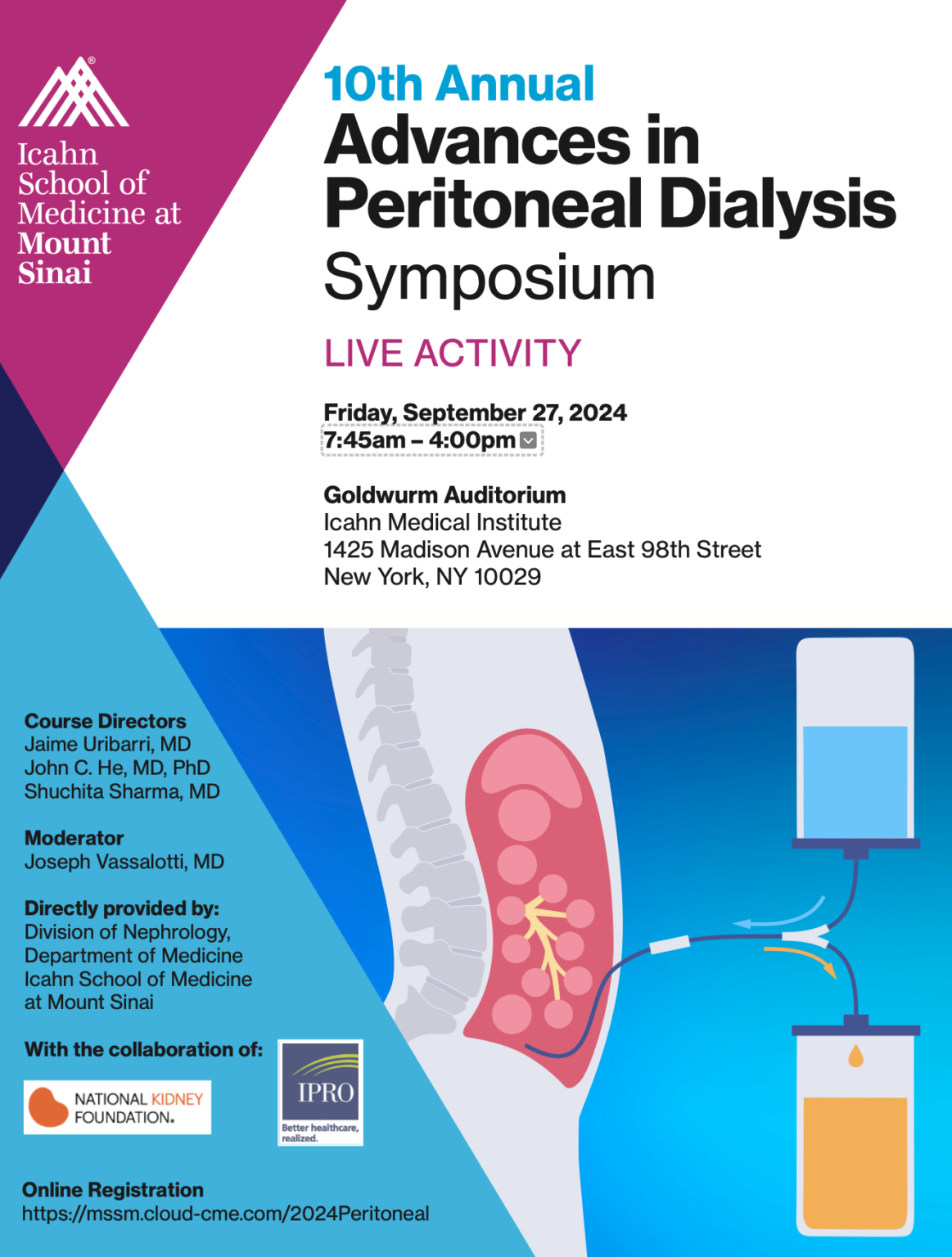
Icahn School of Medicine Advances in Peritoneal Dialysis 2024

$20.00
This Product is shared via google drive download link, So please share your correct Gmail id while placing the order .Please note that there are no CME points or certificate associated with this course Samples for Courses Can be found here : Free Samples Here!
Include: 12 videos + 1 pdf, size: 5 GB


Icahn School of Medicine Advances in Peritoneal Dialysis 2024
Modern Home Dialysis Strategies, PD Innovation & Kidney Care Updates
Peritoneal dialysis (PD) continues to gain renewed attention as healthcare systems increasingly prioritize home-based therapies, patient-centered chronic kidney disease management, and alternatives to conventional in-center hemodialysis. The Icahn School of Medicine Advances in Peritoneal Dialysis 2024 conference provides a focused and clinically practical review of modern peritoneal dialysis care, exploring current developments in PD technology, patient management, catheter placement, home dialysis policy, metabolic complications, and the future direction of kidney replacement therapy.
Hosted by the Icahn School of Medicine at Mount Sinai in New York, this one-day educational conference brings together nephrologists, dialysis nurses, clinician-scientists, surgeons, and kidney care experts to discuss the evolving landscape of home dialysis and long-term renal replacement therapy.
The program reflects a broader shift occurring throughout nephrology. Peritoneal dialysis is no longer viewed solely as an alternative dialysis modality for selected patients; it is increasingly recognized as a central component of patient-centered renal care, healthcare accessibility, and long-term chronic disease management.
Course Details
- 12 Video Lectures
- 1 PDF File
- Total Size: 5 GB
- Conference Date: September 27, 2024
- Location: Goldwurm Auditorium, Mount Sinai, New York, NY
The Growing Importance of Home Dialysis
Home dialysis has become an increasingly important area of focus in modern nephrology due to:
- Rising CKD prevalence
- Expanding dialysis populations
- Healthcare cost pressures
- Patient quality-of-life considerations
- Transportation and access barriers
- Workforce limitations in dialysis centers
- Policy initiatives supporting home therapies
Peritoneal dialysis offers several potential advantages, including:
- Greater patient autonomy
- Flexible treatment schedules
- Preservation of residual kidney function
- Reduced transportation burden
- Home-based chronic disease management
At the same time, PD introduces its own complex clinical challenges involving:
- Patient training
- Catheter complications
- Infection prevention
- Volume management
- Metabolic control
- Long-term adherence
The conference appropriately approaches PD not as a simplified alternative to hemodialysis, but as a sophisticated and evolving renal replacement strategy requiring multidisciplinary expertise.
Lessons From the UK Experience in Peritoneal Dialysis
One of the major sessions examines the UK experience with peritoneal dialysis and what can be learned from international dialysis systems.
The discussion explores:
- PD utilization strategies
- Healthcare infrastructure differences
- Patient selection models
- Home dialysis integration
- Long-term outcomes
- Policy-driven adoption approaches
International comparisons are particularly valuable because peritoneal dialysis utilization varies dramatically between healthcare systems.
In practice, dialysis adoption often depends not only on clinical evidence, but also on:
- Reimbursement structures
- Training resources
- Institutional culture
- Workforce expertise
- Patient education systems
The course highlights how healthcare policy and infrastructure can directly influence renal replacement therapy access and outcomes.
Glycemic Management in Peritoneal Dialysis Patients
Managing diabetes in patients undergoing peritoneal dialysis remains one of the more complex metabolic challenges in nephrology.
The glycemic management lecture reviews:
- Glucose absorption from dialysate
- Insulin adjustment strategies
- Continuous glucose monitoring considerations
- Nutritional management
- Metabolic complications
- Hypoglycemia risk assessment
Clinical decision-making becomes particularly difficult because PD patients frequently experience:
- Fluctuating glucose exposure
- Altered insulin clearance
- Progressive cardiovascular disease
- Nutritional instability
- Complex medication regimens
The conference appropriately emphasizes individualized diabetic management rather than rigid glycemic targets alone.
CKD Education & Dialysis Modality Selection
One of the most clinically important areas in kidney care involves educating patients about dialysis options before kidney failure occurs.
The roundtable discussions explore:
- CKD education outreach
- Shared decision-making
- Dialysis modality counseling
- Early nephrology engagement
- Barriers to informed patient choice
Many patients initiate dialysis urgently without adequate exposure to:
- Home dialysis options
- PD eligibility considerations
- Lifestyle implications of different modalities
- Long-term treatment planning
The course highlights how earlier and more effective CKD education may substantially improve:
- Home dialysis adoption
- Patient satisfaction
- Treatment adherence
- Quality of life outcomes
Peritoneal Dialysis Catheter Placement & Procedural Considerations
Successful PD often depends heavily on catheter function and procedural technique.
The catheter placement session reviews:
- Surgical placement techniques
- Catheter positioning
- Access complications
- Infection prevention
- Mechanical dysfunction
- Long-term catheter maintenance
Many PD failures occur not because of dialysis inadequacy itself, but because of:
- Poor catheter performance
- Recurrent infections
- Mechanical complications
- Insufficient procedural planning
The conference appropriately emphasizes the importance of multidisciplinary collaboration between:
- Nephrologists
- Surgeons
- Dialysis nurses
- Interventional specialists
to optimize long-term PD success.
Resilience, Mental Health & Chronic Dialysis Care
One of the more distinctive aspects of the conference is its attention to resilience and chronic disease psychology in dialysis patients.
The discussions examine:
- Emotional burden of chronic kidney disease
- Long-term treatment fatigue
- Patient resilience
- Behavioral health considerations
- Quality-of-life challenges
- Coping strategies in chronic dialysis populations
In practice, dialysis management frequently extends beyond laboratory values and ultrafiltration goals.
Clinicians increasingly recognize that:
- Depression
- Burnout
- Social isolation
- Anxiety
- Treatment fatigue
may significantly affect dialysis adherence and overall patient outcomes.
The inclusion of resilience-focused discussions adds meaningful clinical depth to the program.
Artificial Intelligence & Future Applications in Peritoneal Dialysis
The conference also explores emerging applications of artificial intelligence in PD care.
Topics include:
- Predictive analytics
- Remote monitoring systems
- AI-assisted dialysis management
- Data-driven risk stratification
- Personalized treatment optimization
Although AI integration in nephrology remains early in development, home dialysis may represent one of the most promising areas for technology-assisted chronic disease monitoring.
The discussions appropriately balance innovation with realistic acknowledgment of:
- Data limitations
- Workflow integration challenges
- Clinical oversight requirements
Administrative & Policy Barriers to PD Expansion
Despite growing support for home dialysis, many healthcare systems continue facing operational barriers that limit PD growth.
The administrative sessions review:
- Reimbursement structures
- Regulatory barriers
- Workforce shortages
- Training limitations
- Resource allocation challenges
- Infrastructure needs
These discussions are particularly important because dialysis access and modality selection are often shaped as much by healthcare systems as by patient-level clinical factors.
The course highlights how improving home dialysis access requires coordination between:
- Clinicians
- Healthcare administrators
- Policymakers
- Dialysis organizations
The Future of Peritoneal Dialysis
The future-focused sessions examine evolving directions in:
- Home dialysis technology
- Wearable dialysis concepts
- Remote patient monitoring
- Expanded PD eligibility
- Integrated CKD care models
- Patient-centered renal replacement therapy
The conference reflects a broader movement within nephrology toward:
- Earlier intervention
- Home-based chronic disease management
- Personalized renal replacement planning
- Improved patient autonomy
Educational Structure
The course combines:
- Expert nephrology lectures
- Multidisciplinary panel discussions
- Patient-centered roundtables
- Health policy analysis
- Procedural education
- Future technology discussions
Featured faculty include:
- Andrew Davenport, MD
- Adam M. Segal, MD
- Shuchita Sharma, MD
- Stephen Haggerty, MD
- Lili Chan, MD
- Thomas A. Golper, MD
- Osama El Shamy, MD
and additional nephrology and dialysis experts.
What’s Included
- 12 peritoneal dialysis video lectures
- 1 PDF conference file
- Total size: 5 GB
- Home dialysis updates
- PD catheter placement education
- Glycemic management in PD
- AI applications in dialysis
- CKD patient education strategies
- Health policy and administrative discussions
Why This Peritoneal Dialysis Course Matters
As chronic kidney disease continues expanding globally, home dialysis is becoming increasingly important in delivering sustainable, patient-centered renal replacement therapy. Yet successful PD programs require far more than technical dialysis knowledge alone—they demand expertise in chronic disease management, patient education, procedural planning, metabolic care, healthcare systems, and long-term psychosocial support.
The Icahn School of Medicine Advances in Peritoneal Dialysis 2024 conference provides a thoughtful and clinically relevant review of these evolving challenges. By combining nephrology science, practical PD management, patient-centered care, and healthcare policy perspectives, the program offers valuable insight into the rapidly changing future of home dialysis and chronic kidney disease management.
Related products

Medical Accounts

Critical Care - Emergency medicine
The Brigham Board Review in Infectious Diseases Brigham and Women’s Hospital Board Review

USMLE / kaplan and Board Review
Uworld USMLE COMLEX Level 1 Qbank, Updated Jan 2023, System- and Subject-wise (PDF)
Critical Care - Emergency medicine
40th ISICEM International Symposium on Intensive Care & Emergency Medicine 2021

Critical Care - Emergency medicine
Critical Care - Emergency medicine

Critical Care - Emergency medicine
Critical Care - Emergency medicine
2022 ISICEM International Symposium on Intensive Care & Emergency Medicine